Special List #21: What I'd Tell My Younger Self After 31 Years in Solo Practice with Dr. Eman Traynor
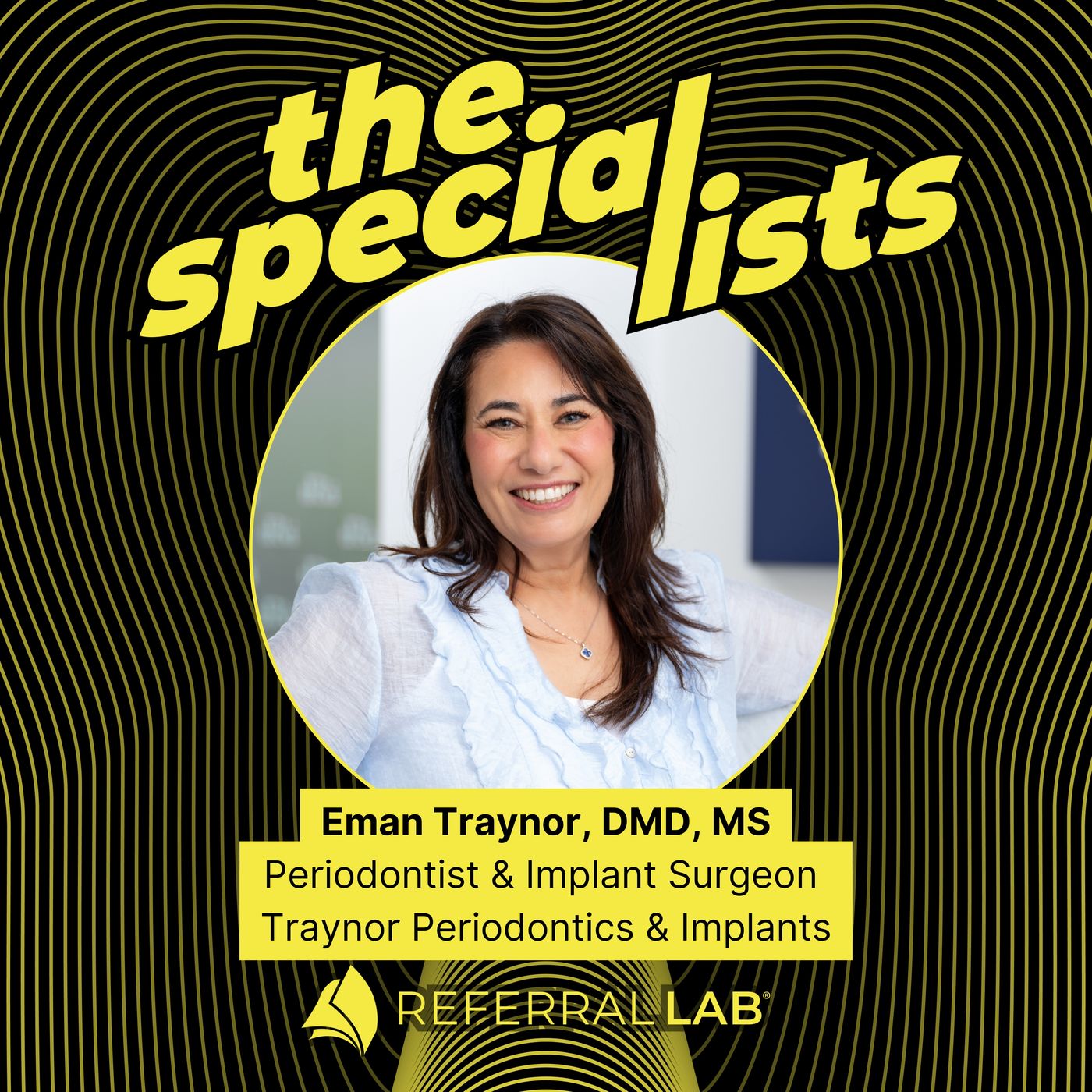


The thing nobody tells you about running your own dental practice is that the anxiety doesn't quiet down — it just gets louder for the first 20 years, and then you look back and realize none of the things you were afraid of actually happened. Eman Traynor knows. She built Traynor Periodontics & Implants from scratch in Greenwich, Connecticut in 1998 and ran it solo for 27 years on a steady drip of stress she now wishes she'd ignored.
What follows is her special list: five hard-won lessons from a 31-year periodontics career, the ones she wishes someone had handed her at the start.
Leading with embracing risk and failure, she admits anxiety is part of the path, but the path leads somewhere good, and you arrive whether you enjoy the trip or not. Eman didn’t, and that’s the regret she opens with.
Walking through operations, she advises systemizing everything because discipline sets you free. Hire one more person than you think you need, because running lean costs more than the salary you saved.
Master your data, because you can’t run a business on feel. She names her consultant (Mary Ann Spears), her platform (Referral Lab), and the moment she stopped reacting emotionally to bad days because she finally had the numbers to tell a different story.
On technology, her rule is simple: never buy version one. She likes Freed.ai for chairside notes (it learns her words and emails the patient a summary after the consult), but she’s not an early adopter, and that’s by design.
She closes with her case for solo practitioners not staying solo in spirit. The five people you spend the most time with shape you. For Eman, those five came from the Seattle Study Club, including her hosts Cameron Full and Dr. Michael Seda.
Guest
Dr. Eman Traynor is the founder and solo periodontist at Traynor Periodontics & Implants in Greenwich, Connecticut, where she has been in private practice for over 27 years. She earned her DMD at Washington University School of Dental Medicine in St. Louis in 1991, completed a general practice residency at Barnes/Jewish Hospital at Washington University Medical Center, and earned her Master of Science in periodontics at the University of North Carolina at Chapel Hill in 1995, where her research focused on the link between insulin-dependent diabetes and periodontal disease. Her practice is an affiliate of the Seattle Study Club, and she directs both Traynor Periodontics & Implants Study Club and an affiliated hygiene study club. Born in Egypt and raised between the UK and the US, she built her Greenwich practice from scratch in 1998 and has stayed solo ever since.
Learn more about Traynor Periodontics & Implants: tpigreenwich.com.
Follow Eman's practice on Instagram @traynorperiodontics
Questions answered by this episode:
1. How do solo dental practitioners deal with anxiety long-term?
2. Why do most dentists hold onto employees too long?
3. Is it better to over-hire or run lean in a dental practice?
4. How do you build standard operating procedures in a dental office?
5. What KPIs should periodontists track to grow their practice?
6. Should I be the first to adopt new dental technology?
7. Does Freed.ai work for chairside dental notes?
8. Is the Seattle Study Club worth joining as a solo dental specialist?
9. How do you start a solo periodontal practice from scratch?
10. What advice would a 30-year periodontist give her younger self?
About The Special Lists
The Special Lists, presented by Referral Lab, is the podcast for dentists and dental specialists. Running a dental practice isn't easy, and if you're in private practice, it can sometimes feel like you're on an island. That's why finding your people—those who've been in your shoes and can share real, lived experience—changes the game.
Referral Lab was built specifically for dental specialists, helping you track, manage, and convert every referral. It's about improving case acceptance, boosting team performance, and strengthening relationships with referring providers so your whole practice runs smarter.
This spirit of connection fuels The Special Lists podcast. Hosted by the team behind Referral Lab, we bring you wisdom from practice owners and dental professionals, sharing the wins, mistakes, and lessons that shape how they run their businesses today.
Got a question for us? Send us a message at speciallists.com (with two L's)
Transform your referral workflow with Referral Lab, the purpose-built platform for dental specialists to track, manage and convert every referral. Request a demo at referrallab.io
Hosts
Cameron Full
Co-Founder of Referral Lab
Cameron Full, co-founder of Referral Lab, is a strategic problem-solver with expertise in business management and digital solutions. He combines leadership, creativity, and technology to drive success across various industries.
Connect with Cameron on LinkedIn
Jason Souyias, DDS
Periodontist and Co-Founder of Referral Lab
Dr. Jason Souyias is a periodontist, educator, and co-founder of Referral Lab software. He teaches dentists and hygienists, including as a Pikos Institute faculty member. In his Port Huron private practice, he's known for excellent patient communication and experience. He's passionate about his work and dedicated to helping other dentists.
More about Port Huron, Michigan periodontist Dr. Jason Souyias
Michael Seda, DMD, MS
Periodontist and Co-Developer of Referral Lab
A clinician and entrepreneur, Dr. Seda brings 19 years of private practice experience to his periodontal and implant surgery practice in the San Francisco Bay Area. Dr. Seda's education spans several disciplines, including a degree in Psychobiology from the University of California, Los Angeles, a Doctorate degree from Harvard University (DMD), and a Master's degree in Periodontics and Oral Medicine from Columbia University.
More about Bay Area periodontist Dr. Michael Seda
Follow Dr. Seda on Instagram @sedaperio
Co-hosts: Cameron Full, Jason Souyias, DDS & Michael Seda, DDS
Producer: Eva Sheie @ The Axis
Assistant Producer: Mary Ellen Clarkson
Engineering: Cameron Laird
Theme music: Papa Funk, spring gang
Cover Art: Dan Childs
The Special Lists is a production of The Axis.
Dr. Souyias (00:00):
Thanks for listening to The Special Lists presented by Referral Lab, the podcast for dentists and dental specialists.
Cameron Full (00:10):
Welcome to another episode of The Special List. I'm Cameron Full, your host with my co-host, Dr. Michael Seda.
Dr. Seda (00:19):
Good afternoon.
Cameron Full (00:21):
And unfortunately this evening we do not have our other co-host, Dr. Jason Souyias.
Dr. Seda (00:25):
The third amigo is-
Cameron Full (00:26):
The third amigo.
Dr. Seda (00:27):
Absent today with a family commitment.
Cameron Full (00:30):
Family commitment, which came up, which we are pleased to cover for him. Those are important things. And tonight we welcome Dr. Eman Traynor. Dr. Eman Traynor is a periodontist and owner of Traynor Periodontics and Implants, which I'm not going to be able to stop myself. The reality is her practice is beautiful. I was fortunate enough to visit her practice. Was it what? A year ago, Eman?
Dr. Traynor (00:56):
I think it was a year ago. Yeah.
Cameron Full (00:59):
Yeah. And I'm telling you that this practice is gorgeous and it represents the quality of care that she gives as well as the respect for her profession herself and her team. It's remarkable. A lot of practices are gorgeous, but if you ever have a chance to visit her, she's in Greenwich. Please, I'm inviting them for you, I guess.
Dr. Traynor (01:25):
No, I welcome everybody. Come and see me first.
Cameron Full (01:27):
It's a gorgeous practice. I'm sure I'll touch on-
Dr. Seda (01:30):
That's Greenwich, Connecticut, just to be more specific.
Cameron Full (01:33):
Thank you.
Dr. Seda (01:33):
Yeah. Greenwich Connecticut.
Cameron Full (01:35):
Not Manhattan, right? So Eman is a full-time periodontist for over 31 years. She's been practicing Greenwich, Connecticut for 27 plus. Before that, she practiced a short time in Durham, North Carolina. I did not know that after her Paradix residency before moving to the Northeast. Solo practitioner and started her practice from scratch when she moved there in 1998. Everybody, please welcome EmanTraynor.
Dr. Traynor (02:03):
Hi, nice to be here.
Cameron Full (02:04):
Doctor Eman, welcome.
Dr. Traynor (02:06):
Thank you. Great to be here.
Cameron Full (02:08):
You know what? It's fun when participants ... Before we get going and I, we send out this questionnaire and it kind of helps us guide the conversation because it's a little bit thought provoking when you want to talk about what may or may not be on someone's special list. And so as we reached out, Eman, she took this seriously and she thought for a little while around what she wanted to talk about, which we really appreciate that because as listeners of our show have expressed to us, a lot of the reasons that they listen is because people take this seriously, they're so thoughtful about some of the engagements they bring. And I expect nothing less out of this conversation after getting to know Eman closely over the last couple years and spending some time with her practice and her actually coming to visit me in Chicago at one of our events.
(03:00):
So Eman, you've got a couple things here on the list that we're going to dig into, but anything you want to say before we get going?
Dr. Traynor (03:07):
I've learned so much from listening to some of these podcasts and some of the people that you've had on I know very well, but hearing them talk about their list was very eye-opening and some of the people I didn't know and hearing them talk about their list was also really informative. So I just think it's a great ... We've never had anything like this before because there's so few of us, but I just appreciate it. It's great.
Cameron Full (03:35):
Thank you. Thank you.
Dr. Seda (03:36):
It's an honor to have you here.
Dr. Traynor (03:37):
Thank you.
Cameron Full (03:38):
Let's get rolling here. So let's talk about the first item on Eman's special list.
Dr. Seda (03:45):
Actually, Cameron, before we even get there, Dr. Eman, can you just tell us a little bit about your practice? Are you a sole practitioner? How long have you been there in Greenwich and what's the style of your practice just to orient our listeners in terms of your talents, your joys, et cetera?
Dr. Traynor (04:04):
So I actually was born in Egypt and so my parents and I, we left Egypt when I was about 18 months, two years old, and we immigrated to England. And then from England, we came to the United States. So I've been in the United States since I was seven and going back to ... So my parents are both physicians and had to do their residency three times, once in Egypt, once in the UK and once in the United States. So I saw my parents work so, so, so hard and that does not leave you like that's ingrained and everybody had to pull their weight. And I have a younger brother and when mom was on call and dad was on call, I took care of Pete and you just had to pull your weight. There was no ifs, ands or buts, like they're working, you're taking care of things.
(05:07):
And so hard work was never something I was afraid of. And also my parents really, really encouraged me and my brother not to go into medicine very strongly, do not go into medicine and also own your own business, be your own boss, own your own business. And so those are kind of the principles that I have ingrained in me. And so when I finished my perio residency, I was going to start my own practice and I did not know very much when I did it. So I learned a lot. I made a ton of mistakes, but the mistakes I have learned to view as lessons and I'm grateful for them and you just keep going. You can't stop.
Dr. Seda (06:00):
Well said.
Cameron Full (06:01):
Thank you, Seda, for doing that. I was about to jump in and we got a little bit more about Dr. Traynor here and about our story. So I didn't know he was your little brother.
Dr. Traynor (06:10):
Yeah, Peter's my little brother. He's also a periodontist.
Cameron Full (06:14):
Yeah. For those that know Dr. Traynor's brother's also a periodontist, a great guy. I didn't know he was your little brother. So shout out, Peter, if you're listening. So let's talk about embracing risk and failure. It's important that when we take some of these lists and they're a little bit more personal like this, it's very clear that some of her engagement was very personal. This is a very personal item on a list. So Eman, what do you mean by this?
Dr. Traynor (06:45):
Yeah, that's great. So let's start with that. So I am a highly anxious person, anxiety ridden, whether it's because I saw how my parents worked hard or whether that's just my genetic makeup, but I am very anxious. And so if I were to go back and look, talk to my younger self, I wish I could have told myself that everything is going to be okay. It's all going to work out. It's all going to be okay. I don't know if I would've believed myself, but I really wish that I had said that to myself. It's all going to be okay. And even the mistakes, thankfully, not patient mistakes, obviously, but business and practice mistakes, they're all part of the growth and it's all part of the process and the journey and really it's really about your journey and your growth and who you end up becoming.
(07:49):
And so the scariness of it really should be embraced because it's really through that that you become somebody that you were supposed to be. You know what I mean? Your path will guide you to your future.
Dr. Seda (08:09):
That makes perfect sense. And it's funny that you touch on this. If I may, it's a concept that I've been considering a lot recently and that is the notion of control and how as young ambitious people, if we find ourselves on that side of the spectrum, there's certain things that we want to do to try to guide and control our futures, our success, our achievements, to do the right thing, to help people in our profession and also achieve the benefits of becoming a successful person. And a lot of times one of the biggest sources of fuel for that is anxiety, especially if someone comes from like yourself, I like you am from parents that came from a different country and survival was one of the most important elements of our daily lessons is how do you put things in perspective and achieve so that you can survive and thrive. And what tends to happen oftentimes is we focus on the goal and the path that we're on to get there and a lot of times it's really hard to stop and embrace what's happening in the moment. And if you look at the Buddhist traditions, man, as you'll get to know me, I have a reputation for being kind of the kumbaya Buddhist of the crew and I can get physical, philosophical about it, but
Cameron Full (09:41):
I'm not taking the bait.
Dr. Seda (09:42):
Yeah. No, don't jump on that one. If you look at like a mindfulness practice, right? It's like, what's happening in real time? What do things sound like? What do things feel like? How can I embrace this? And when you're out to achieve, sometimes that gets merked. So I heard a quote the other day that said, "Approach each day like you chose it. "
Dr. Traynor (10:04):
Oh that's really good.
Dr. Seda (10:05):
When you're talking and expressing, it's very vulnerable of you to share that anxiety that you carry with you. And if you could go back and see that each day was just the next step in what has become your life. And it seems to have turned out okay. And it hasn't been without mistakes or regrets in certain ways, but that's all part of the story that ends up being this beautiful life. And anyway, Bravo.
Dr. Traynor (10:32):
No, no, absolutely. Absolutely true. And the other issue is that there is no plan B. I don't have any other training. What else am I supposed to do? This is the only thing I can do. So I have to succeed at this. I have to make this work.
Dr. Seda (10:51):
I'm going to ask you to do a thought experiment with me real quick. And Cameron, I'd love to hear your thoughts on this too. And that is, as we go through and we're on this path for self-actualization, achievement, ambition, whatever, there's certain fears that kind of work their way in, right? Fear of things that can happen, fear of failure, fear of the unknown, et cetera. And if we look back, if I were to ask you, how many of those things that you actually feared in terms of like a worst case scenario that really kept you up at night and brought that anxiety on, how often did that scenario actually unfold? That was my point, right? And I've had this talk with myself recently too. And I think that's one of the neat things about experience in life is that at a certain point, if you're reflective enough, you realize that the things we worry about most often don't even end up being what ends up happening, right?
(11:51):
Exactly. And so you can sit back and relax and take a deep breath and say, this could happen, but all those times before, I'd love to hear your thoughts on that.
Dr. Traynor (12:00):
That's absolutely true. One of the things that I learned through these years, and it's not just practice, right? It was college, getting into a good college, then getting into dental school, then getting into ... And then it was just one after another. And you're right, none of the fears ever came to light and I didn't let myself enjoy any of it. Now I'm on the other side and I look back and I'm like, I was just riddled with anxiety. I didn't enjoy this process at all. And if I could have just enjoyed some of it and really just told myself, "You're going to be fine. Just enjoy this day where you only have one new patient. Just relax and enjoy it."
Dr. Seda (12:58):
Yes. Such an important message for all those listeners that we have that are kind of on that same path is to just try to enjoy it. And sometimes like you had those days early on where there's one or two patients in the schedule and rather than having anxiety around why isn't the schedule full, how about focusing your energy on I'm going to treatment plan these two cases as good as anyone could possibly treatment plan it. I'm going to research and I'm going to use open evidence and I'm going to put all my time and thought and energy into these cases and do them as best I can and then build from there and enjoy that process.That's one of the biggest messages I would give not just to my younger self, but to anyone on that path.
Cameron Full (13:45):
So fear, right? False evidence appearing real, one of the best acronyms I've ever heard. And when I get fearful of things, I remind myself that this is just false evidence, right?
Dr. Seda (13:59):
Where did you hear that?
Cameron Full (14:00):
I don't have any idea.
Dr. Seda (14:01):
It's a great one.
Cameron Full (14:02):
I don't have an idea.
Dr. Seda (14:03):
False evidence appearing real.
Cameron Full (14:04):
False evidence appearing real, fear.
Dr. Seda (14:06):
That is really good, Cameron. I do like that.
Cameron Full (14:08):
The difference and mind you, my parents weren't immigrants. I'm from Iowa, so I might as well be not to minimize what you guys went through for sure. The difference with our family circumstance was we have a sixth generation family farm in Eastern Iowa now. And so we were hard workers and I only knew hard work. And so what's weird about a seasoned entrepreneur eman is like, I think that we get comfortable with the fact that we work when we work and we don't when we don't. I'll never forget my grandfather, one of my favorite things he ever says, "Hey, once you learn to appreciate and love what you do, it all gets easier." And he told that to me as a kid-
Dr. Seda (15:08):
Who was a dentist? Was this the dentist's grandfather?
Cameron Full (15:10):
Yeah, he was a pediatric dentist. He was chair at the peds department, ran the peace department, University of Iowa. So all days end in Y, weekends were determined by, I think the history by the Industrial Revolution or something at some point. And so that took away, but back in the day, like when you were a cobbler, they'd drop off shoes and you'd do the thing and you'd work when there was work and then when you didn't, you'd not work and you wouldn't try to manifest this stuff like, "I should be busy right now because it's two o'clock on a Tuesday." And so when it's two o'clock on a Tuesday and I'm not slammed, I either do something that I really enjoy that contributes to my work or I wait until a Saturday and I pick it up and now whether that's healthy or not, I don't know, but I've gotten to the flow of appreciating the work necessary at the time that it's necessary.
(16:14):
And that means sometimes we've got weeks that are 70, 80, 90 hours and sometimes we've got weeks that are 10 and allowing yourself to be in that flow, when you do good work, good work ... And so one of my favorite lines is like, "What's the reward for good work?" More work-
Dr. Seda (16:32):
Let me take a guess.
Cameron Full (16:34):
More work. That's the reward. When you do good work, more work follows. When you don't do good work, you probably should do something else and do something that you enjoy. And I know that we come from an entitled position of doing what we love, but that's also the result of doing a hell of a lot of work to get to that place, whether it was formal as a careerman or informal through whatever the process that I got here from. So I love Eman, I love the topic and I think that when Michael said actualize ... I think the place in self-actualization in this is to acknowledge that even though you identify as a periodontist, the reality is that you just provide a service and you're a good person that does that and the service that you provide is fixing gums or dropping implants or whatever, but great topic.
Dr. Traynor (17:25):
Yeah. Yeah.
Cameron Full (17:26):
Great topic. False evidence appearing real.
Dr. Traynor (17:29):
Loved it. That's a good one. I like that.
Cameron Full (17:32):
So from that holistic first point, we're going to dive straight into something that's the opposite. So Eman wants to talk about systemizing operations, which is completely opposite of feeling better about the fact that we're not busy on Tuesday.
Dr. Traynor (17:49):
Yeah.
Cameron Full (17:50):
So what do you mean by systemizing operations, Doc?
Dr. Traynor (17:53):
Okay. So this is something I did not do that I wish I could tell my younger self to do and that is I held on to employees way too long because they knew how to do the job and you're going to hire someone else. It's going to take them a long time to get them up to speed. It's going to be so difficult for them to understand everything. I held on for too long and I've come to learn that through many people that have helped me, so I appreciate all the people that have helped me. I have come to learn that you systemize or have a standard operating procedure for almost every single thing in your practice and that discipline. So one of my favorite sayings is the discipline sets you free, whatever that discipline may be. So the discipline of systemizing and having standard operating procedures and having everything written down, it sets you free.
(18:58):
You're not bound to somebody that's not really working for your best interest and you are able to change and have a new system and everybody will go with the flow. So to me that systemizing and operations, while it's such a time-consuming task, it really is a task that I did not love and don't love, it's really the freedom that it gives me I love and I didn't understand it until I had it. And that's when I realized I really wish someone had told me that long ago and the freedom that it would have given me and the peace of mind I would have had, I would have just relished it, but I didn't know. I just didn't know. So that's what I'm talking about.
Cameron Full (19:56):
How about you give us an example of one of those things that you SOP that really changed how you manage your team or manage your practice?
Dr. Traynor (20:04):
Yeah. So let's talk about new patient intake. You want to systemize exactly where they're going to enter the data, what software they're going to enter the data in, what information they need, what they're going to say on the phone, what they then need to do for the referring doctor to get the information from the referring doctor. Just have it all laid out for them so that when the new patient comes, you're not caught off guard, you don't know where they came from and you don't know why they're there because sometimes the patient doesn't even know why they're there. And so just really having a protocol for that specific step is great.
Cameron Full (20:52):
The truth of it is if you don't have systems in place to manage the engagements that happen as the individuals move through your practice, the individuals that are responsible for those engagements will build their own. And when they build their own, then you don't have any acknowledgement as to what that system is and that system entirely depends upon that person. And more often than not, like in respect to the individuals that we're hiring in our practices or in your practices rather, it's not that they're doing it by ... They're building a system because they don't know what else to do. They're trying to figure out on their own and it was our responsibility to put some in place to support them before. So this is really an us problem,
(21:42):
Not providing enough clarity necessary for them to do their job better. And more often than not, it's a result of us not taking the time and energy necessary to do that because we don't think that there's as much of a reward as there is. Well, the reality is, is that once you do that work, the reward is bountiful and then you see that, oh man, where else can I do this? And it becomes infectious to implement those systems in any possible place you can in the practice. I know Seda's big on this in his practice too. Seds, you got comments on this?
Dr. Seda (22:13):
So a few things come to mind as I hear the discussion. The first is systems are important, not merely for guiding people and providing some sort of template to help people know what their roles are, but it also helps us in the event that invariably will present itself, which is we're in the people business. We're dealing with patients, we're dealing with teams and people have lives, right? They get sick. They have children at home that need them from time to time and there are things that will take team members out temporarily and having systems in place allows everyone else to kind of fill the gap. If they know the system, then they can kind of, they're countertrained and the system allows the machine to keep moving. Without systems, as Cameron said, you unplug someone from the machine, the whole machine breaks down. So cross training as part of the systems is something that we kind of really emphasize and is something that I think is super important.
(23:21):
A second corollary to that is, and I'd love to hear Dr. Eman's thoughts on this, is as business owners, we want to run ideally streamlined tight ships with very little waste and the largest source of overhead for most of our practices is the salaries that we pay team. And sometimes we try to really walk a fine line between having people in their positions to help the machine move forward, but also not do so excessively where we're bleeding overhead. And what I've come to learn having made this mistake going back to mistakes we've made and things that I wish I had been told earlier, things I would go back and tell my younger self is over higher because when you have enough people on the team, then things flow better and when someone steps out, someone else can step in because they're not so bogged down with what they have to do and yes, it costs the business more and especially if you're starting out, you've got loans to pay and all these other concerns, but the concept of not running so lean that it comes at the cost of A, the system breaking down or machine breaking down when someone exits and two, also why don't we talk about just the morale and state of mind of everyone on the team, right?
Dr. Traynor (24:50):
Yeah.
Dr. Seda (24:50):
I've gotten more mature and more gray as we can all tell, although I've been told the great silver fox look does look good on me. One of the things that I've learned is how important the morale of my team is. It's in fact the most important thing I should be kind of looking for because how can we provide the best care possible for our patients if the team that's helping to support that care is stressed out, overworked and just in a negative mindset because they have too much on their plate, right? So for all these reasons, I think staffing in the right level of staffing is something that everyone should look at and then we can work with the systems to implement systems for the team to know their roles and help the machine run and flow smoothly.
Cameron Full (25:43):
Absolutely
Dr. Traynor (25:45):
100% agree with you there. 100%. Yeah. Absolutely.
Dr. Seda (25:49):
And have you ever found yourself at a point in your practice where watching the bottom line and wanting to be what you thought was a sensible, thoughtful business owner that wasn't wasting, but then you found that perhaps maybe you didn't have enough people to support the goals that you had and the patients you wanted to treat, et cetera. Did you ever find yourself in that position?
Dr. Traynor (26:11):
Yes. And that's when I decided that what I really need to do is over hire or hire just a little bit more than I need because I'm so stressed I'm losing sleep at night because what if this happens and they don't come into work or what if? And it's not worth it. It's just not. And they're happier too. I'm happier and they're happier that not everything is on one or two people's shoulders. It is very good for the morale, but it is very good for the doctor too because it just alleviates a lot of stress.
Dr. Seda (26:56):
And so I'd love to double click on one thing you said and that is that's when you started to overhire, right? But I think if we really look at it logically, overhiring is actually the appropriate level of hiring. In our minds, we have this subconscious probably arbitrary level of what we think should be the right hire. And so if there's one message I could get about this, get out there to everyone listening is like, if you think you're at a certain level of appropriate hiring, you usually should probably be slightly above where you think it's appropriate. And unfortunately for me, it's only through suffering do I sometimes learn the lesson. And so I have like you, suffered greatly at the hands of myself where I've handcuffed myself and as you said now it's like, okay, someone's out, personal reasons, life happens, let's keep rolling and yeah.
Cameron Full (27:55):
Well, I think that the expectation is like people need to be busy 100% of the time. And when you've got positions in your practice or even in your businesses or whatever you're doing on your listeners, when that person's at 100% bandwidth, there's no room for growth. There's no room to put anything and believe it or not, especially Eman at the new patient intake position, right, especially like you can see with referral lab data when a doctor's gone for a period of time, the doctor comes back, he or she slams a ton of consults on the schedule like a ton, like more than normal and then that same treatment coordination team is now seeing twice as many treatment plans as they typically do. Well, where's that resource come from? It comes from time and it comes from energy around that time. And so you assume that that conversion's going to stay the same.
(28:54):
The reality is, is the conversion decreases, no different than the new patient intake position. All of a sudden the guy down the street closes up shop, you get a swell of referrals. We just saw this in a practice last week we were talking to, swell of referrals and they wondered, oh my gosh, why aren't we getting them all scheduled right away? Well, the reality is, is that that same individual that was handing 100 or 125 referrals last month, now you gave them 175 to handle and they have the same amount of time to do it in. And so this is a bandwidth thing and somewhere along the way and I don't know, respectful of our business team or administrative teams, obviously in perio practices, the hygienist is very expensive typically in the practice, so it's difficult to carry an extra hygienist, right?
(29:42):
We don't want an extra ... I mean, we would love to have an extra hygienist, but the reality is that's not likely. With front office administrative team members, arguably we can make budget to carry somebody that supports an additional role where we've got a bottleneck. Dr. Traynor, master your data.
Dr. Traynor (29:58):
Okay.
Cameron Full (29:59):
What's it What are you talking about?
Dr. Traynor (30:02):
I need number three on the list. I need number three on the list.
Cameron Full (30:05):
You and I talk about-
Dr. Traynor (30:07):
So I knew nothing about my data, nothing zero, nothing. I didn't know anything about my data. I just thought you just did whatever walked through the door. I had no idea. And so understanding, and this is where honestly referral lab really helps, but not only that, but then just looking at all the codes, how many times you've done this procedure, how many times you've done this procedure, are the hygienists doing fluoride or are they not doing fluoride? Just knowing your numbers because our practice is really our baby. It's our child and we've put as much into this as we would have put into a child. And so it's a very emotional knee jerk response when you see a problem. But really if you can understand your numbers, you can gamify your data, you can say, "Well, hey, what if we added more treatment conferences in the day?
(31:19):
How would that affect conversion?" In so many ways you can gamify once you've got your data, but you can have fun with your data, but you need to know what your key performance indicators are. And even though I'm not great at it even now, but I have tools to help me so that I don't get as emotionally reactive when anything happens. I can look at the data to support my next move, which is really what it's all about. We're running a business, we need to act like business people, which we never, ever, ever, ever were taught how to do. We don't know how to run a business. And so you can't run a business without data. And that's really the learning point there. That was big for me.
Cameron Full (32:12):
When do you think that transition happened for you?
Dr. Traynor (32:16):
I started to realize that I needed to know key numbers in my practice, but I didn't really know what was important. I couldn't figure out what am I supposed to know? I don't know what I'm even supposed to know. And really that's when I started reaching for help. And my consultant was Maryanne Spears who really showed me how she takes the data and then she can read it very quickly and then make changes and I would see an immediate result. And so I just would watch her do it that I learned from her. She's a great teacher.
Dr. Seda (33:03):
Where did you connect with the consultant initially? Yeah.
Dr. Traynor (33:08):
Yeah. So I'm part of the Seattle Study Club and that has been great for me. And many, many people have utilized them, many periodontists and other dental specialists, but many periodontists have. And so I thought, I'm going to jump in. I'm going to take the leap. I think I need to do better than I'm doing and I need help. I don't know how to do it.
Cameron Full (33:39):
Using numbers in your practice to tell a story is a powerful thing. And if you don't do that, then you're going to create your own story without the numbers. And so Seda and I talk about this a lot because obviously as Seda being part of referral lab, there's so much information available in the software. It's knowing what to use at what times. And so no different than with APCs, big spreadsheets. It's like not everything's important all the time, but it's about knowing what things point to what things so that when this particular number's off a little bit, it allows your mind to open up to the six numbers that are attached to that number. And then one of those six things is the problem or, oh man, the growth, right? Why is this up so much? What happened? And then there's six numbers attached to it.
(34:30):
Well, these two things grew. Well, why did they grow? And then you'd ask the next question and the next question. Then before you know it, you have your story. And so what's cool about that is that that absolutely correlates with the conversation we had prior, which is human capital because oftentimes when there's boundary constraints or bottlenecks in the practice or the KPIs tell the story that's attached to a human being and that human being is either excelling at their position or struggling at their position. And so do we need to get them help or do we need to get them training or do we need to get them gone? And that's one of the things that typically follows a KPI changing. And that's no different than us as or y'all as providers or the associates that are in the practice too, the KPIs are attached to them too.
Dr. Seda (35:15):
Having an organized approach, we've talked about this several times on the show. An organized approach to looking at the numbers and then involving the team to collaborate in terms of making sense of them and then the action items that come from them. I think it's a trend that we're going to see more and more of. Eman, what kind of platforms do you use to monitor the numbers and collect data in your practice? Do you use electronic medical record? Do you guys use spreadsheets? How do you guys track?
Dr. Traynor (35:54):
We were using Excel spreadsheets. We still use some Excel spreadsheets for supply orgs and tracking what we're ordering from various bone membranes, implants, but we use Referral Lab for tracking new patients and then tracking the conversion from new patients to patients that actually become patients and then tracking their treatment flow. We are doing extraction, then they're going to do ortho, then we're going to come back and do an implant, tracking the stages, which honestly in an Excel spreadsheet that was very, very, very difficult to do.
Dr. Seda (36:44):
Would you say that in this case, I guess Referral Lab, would you say it's a big part of the systems that you guys have implemented in terms of helping people to know their roles, not letting patients fall through the cracks, being efficient with getting patients in in a timely fashion, et cetera?
Dr. Traynor (37:03):
Yeah. Because what it does is before I used to run a lot of reports. I would run a report on, okay, well, what extractions have we done within the last however many? Now, how many of those patients have come back for their implant? And it was very kind of labor intensive. And so having it very easily tracked in terms of, and then a reminder, we would set a reminder, but then the reminders will get to be too many and now you've got to clear all the reminders. So it just became very labor intensive without an actual platform to help guide treatment planning and treatment. I'll plan the treatment, but the treatment is in phases and we have to do certain things before we can do certain procedures. And before that we were just relying on Excel or relying on the practice management's reminder system or it was just all over the place.
(38:12):
And then if that person who was managing that went on vacation, then we just had to wait until that person came back and it was just not a good way to run a business. It was just not a good way to run a business.
Dr. Seda (38:29):
You hear yourself now and it's so obvious, right?
Dr. Traynor (38:31):
Yeah.
Dr. Seda (38:32):
And I think for many people out there, it's like, "Oh, well, you've got to have this additional thing that you've got to deal with. " But when I hear you talking, it's funny because we have the same platform and it doesn't have to be that, right? It can be any platform that just helps you organize. I mean, naturally, I'm biased towards referral lab because I think it's the best one, but having to chase things versus things just being a part of a reminder system is just one of the most important functions of any digital platform that one should use to track patients. I've been thinking about a concept recently where when I became a dentist, I had no idea how many steps and details would go into a patient coming in for literally one procedure, right?
Dr. Traynor (39:24):
Exactly.
Dr. Seda (39:25):
Add a second procedure to that, right? And have that procedure be one that has to happen six months later from the first one. And the degrees of complexity that come with each added step in a treatment sequence. It's a miracle that any of it gets done at all and it's actually, it speaks to the competence and the care that our teams bring to the equation. We trust our teams to help allow that very complicated process unfold and hopefully what's a seamless way for our patients and for the doctor. And so giving the team tools to make it as easy as we can for them is something that I think is our responsibility and something that there are platforms out there now that we can do that with. So anyway, thanks for sharing that. That was helpful.
Dr. Traynor (40:17):
I mean, I would go to bed at night and then at two o'clock in the morning, "Oh my God, did we call her? Is she on the schedule? Does she know she..." And it was just-
Dr. Seda (40:29):
And it's like, now you don't need to worry about it, right? You're sleeping like a baby.
Cameron Full (40:34):
This raises a really interesting topic you guys and that is like as we segue into the next topic about tech, just because it's new doesn't mean it's better to use. And I've mentioned this before, but with some of this patient management stuff, I was on a call, there's a text infrastructure that just randomly texts people that are in your unscheduled treatment list. And with how many dentistry states, 200,000 or something?
(41:06):
There's a fair amount of dentistry that can be done using a system, but the reality is like when you're trying to present something as comprehensive as you are and the level of care necessary to communicate what that looks like for the patient and the engagement necessary front, not only our practice but for them, do you really want that coming through a text message? And I think part of the game of this is like knowing what technology to use when and why is the gift is like really a gift in itself. I know plenty of people that just go buy it because it's new and then they try it and they're like, "This is crap." And it's like, "Well, number one, did you use it as it was intended to be used, number one. And number two, did you really need it to begin with or did you do it because ... " I mean, when we were doing early referral lab, we have guys like, "Oh, I want to buy it, but I want to buy restrictive space of my market." And so that happens a lot of space too in tech. It's like, "Hey, can we- "
Dr. Seda (42:06):
What do you mean by that, Cameron?
Cameron Full (42:09):
"I want to be the only users in Marin County. Can we buy restrictive rights?" And I'm like, no, that's not how this works, but it's because they see all technology as competitive advantage. And the reality is it's like, well, not all tech is competitive advantage. Some tech is for sure. But when you look at, and when we go into leveraging technology, I think there's a wisdom that comes with, okay, where does this fit into my tech stack, whether it's procedural or administrative and what value does it ad to my practice or my space or my teams and what's the ROI look like? Is it procedural ROI? Am I expanding my services or is the ROI in time or anxiety savings? Are you making enough money with your practice or are you profitable enough that you can expend just for an ROI of anxiety? I mean, I'll do that all later.
(43:07):
My greatest RO is time. Does it save me time? If this thing saves me time, then it's worth its weight and goal. Eman, talk a litle bit about what you mean by leveraging tech.
Dr. Traynor (43:17):
Leveraging technology. So my husband-
Dr. Seda (43:21):
So point number four on the list.
Cameron Full (43:23):
Thanks, Seda.
Dr. Traynor (43:23):
Point number four, yes, leveraging tech. My husband is a CFO. He's a serial CFO for startups. And so he always told me never buy the first version of anything because they've got bugs and they've got to work it out. So sit tight, never be the first one to get something, just wait. And then when you wait like that, you can see, is it going to make it? Is it worth it? Or usually the second generation is better. And so I personally just try not to be ... I love technology, but I'm not going to be the first one to do the latest gadget or the newest thing. I'm going to wait and watch. I won't be the last one, but I won't be the first one because I do love tech. And so out of necessity, we have had to use a lot of technology.
(44:25):
So I use freed.ai, F-R-E-E-D.ai for all my note taking. The staff knows to turn it on as soon as we're with a patient. And what I love about it is it will make a summary email that they can then email to the patient after a treatment conference so that the patient, because they don't always remember that it's just a lot of information, but it learns our words and it learns our discussion and it creates a very nice note for me and I love freed AI. So just leveraging technology so that A, it saves you time, B, helps make your life easier and eliminates stress. And so that's what I mean by leveraging technology. I don't mean go out and buy anything that's new and put it in your office because it's also very expensive to be a dentist and our toys are not cheap. So if you're buying something, you better use it because putting it in the corner isn't really a smart thing to do.
Cameron Full (45:41):
I'll never forget I was so anxious to use the Android phone when the first version came out, I went and got it. And I'm like you, Amanda, I'm not ... What's it called? First mover, early adopter.What's the difference? What's the second phase? Is it early adopter?
Dr. Traynor (46:00):
I don't know.
Cameron Full (46:00):
I think first move ... And that was the only thing. Well, two things. I did that on that and it was just a piece of junk. It was horrible and I was just too proud to let it go that I kept using the damn thing. And then two years ago or whatever, I had this AI function that I've been working on for quite some time. Sada knows about what the repository videos. And so I was first mover on some of that stuff as well and I spent so much time working on a project that was never going to go and I just committed so much time because again, of the pride of, I'm going to do this, it's going to work. I invested in ... And then you have to have the sunk cost fallacy problem too, whereas I put so much time and money into it, now I've got to keep going.
(46:47):
And I think that's the problem with being a first mover on some stuff before you wisely wait until second phase or third phase comes out.
Dr. Seda (46:57):
I think kind of having a ... You got to kiss a few frogs before there's a prince mindset with technology. Don't be afraid to get in there and mess around with it and it may not be the right thing for you eventually and you move on, but there are certain things that I think by holding an open mind and jumping in oftentimes can be a boon. The note taking is such a great example of that, right?
Dr. Traynor (47:26):
Yeah. I love it.
Dr. Seda (47:28):
I had a doctor's appointment recently and it was bizarre to me. First, the assistant comes in and asks me all these questions and then they excuse themselves. Two minutes later, another person comes in, introduces himself as the physician assistant. They ask the same questions and then the doctor asks this third time, same questions and finding a way to just kind of have one person ask, everyone else can just look at what's done in real time and let's move on kind of thing.
Cameron Full (48:05):
Let's segue into our final point, you man, that is be part of something bigger. Be part of something. I love your arc, your trajectory here of your points, because we started with embracing risk and failure, which is a really deep and thoughtful conversation. And then we talked about systemizing operations and hiring and then into the heaviness, which is data utilization and leveraging tech. And then now we're backing it out with being part of something. So it's a very thoughtful arc. So what do you mean by that?
Dr. Traynor (48:41):
One of my first Seattle Study Club symposiums was Nito Cubaine who said, "You are the sum of the five people you spend the most time with. " Now, he didn't make that up. That's a common expression, but you think about that. And so what am I associating myself with? I'm by myself. What's going to help me learn? Where can I share my ideas and have someone share their ideas and we can grow over time together. For me, that was the Seattle Study Club and it's introduced me to people like Jason and Cameron and now you, Mike. And so it just has made it a place where I have found my people. I have great friends there. I have people I can call up and ask them to help me or they can call me and ask me to help them and I would love it if they did.
(49:50):
I'd love to do that. It's just be a part of a community that you can grow with that is not going to stifle you, is not going to restrict you, but has a bigger vision and you can be part as big as you want to be in that vision. It has to align with where you want to go and you can grow with it. But if I never joined it, let's say I never ever joined the Seattle Study Club. I don't really know what my career path would have been. I don't know if I would have ever found seen people who had used APC and liked it and grown with it and trusted them and therefore I did too. I would have never met the people that I met through NASP.
(50:47):
I would have never grown, I fear, into who I have grown into. I would have grown because I can't stay stagnant, but I don't know. I think just being part of something that is really growth oriented and I've listened to a few of your guests and they have other organizations that they enjoy. For me, that was what came through for me and just not being isolated, not limiting yourself, not closing yourself in, but being out there and seeing what the world has to offer because this is really our life. Again, I don't have a plan B so I've got to make this as amazing as I can make it be.
Cameron Full (51:35):
In those groups, I think there's like to grow you have to be vulnerable to grow and being vulnerable is also correlative to intelligence. And so knowing that you're not the best, knowing that there's room for improvement is to also be intelligent and putting yourself in that space where you're not the best, where in fact I want to be in more rooms, I love being in a room where I don't know anything. It's so uncomfortable. What are they talking about? What is this acronym? And then you're trying to use the acronym and you use it wrong and then you're looking it up on your phone and you're like, "How do I pick up this tribal language?" And so it's like such a cool thing that then before you know what you're part of and the next person comes in and you watch them fumble and you watch them flay around and then you call them and they support you and you support them and then 10 years later and 30 years later you've had your practice for 30 years and people are calling you for help.
Dr. Traynor (52:41):
That's exactly right. That's exactly right.
Cameron Full (52:44):
That's also the gift of specialization though, Eman. It's like when you're specialized in your space and you're a knowledge expert, you got there by helping others, but you stay there by helping others, right? And so I think the gift of like Seattle Study Club and organizations such as that is like that space it creates for you to continue to provide for your community that it provided for you to get to where you are. And if you don't do that, then you're not servicing the community which served you, which is shame on you.
Dr. Traynor (53:17):
Exactly. Exactly. You got to give back. So many people, so many people have helped me and you just got to give it back.
Dr. Seda (53:29):
Honestly, I think that's a great spot, man. Really, what a fantastic conversation. Dr. Eman, you're way out there on the opposite side of the country from where I am. I'm in San Francisco, but from what Cameron says, the beautiful practice that you have over there kind of matches and reflects the person that owns it. Thank you for sharing your time with us.
Dr. Traynor (53:54):
Oh, thank you. Thank you so much.
Cameron Full (53:55):
Thank you so much for joining us this evening on The Special List Eman.
Dr. Traynor (53:59):
Thank you. Thank you guys.
Dr. Souyias (54:03):
Thanks for listening to The Special Lists presented by Referral Lab, the podcast for dentists and dental specialists, featuring a special list from a specialist. Got a question for us? Send us a message at speciallists.com with two Ls. Transform your referral workflow with Referral Lab, the purpose-built platform for dental specialists to track, manage, and convert every referral. Request a demo at referrallab.io.