Special List #23: Partners vs. Associates - What Most Owners Get Wrong with Dr. Adam McClellan


Bring a second periodontist into one of your offices and the dentists who send you cases will still ask for you by name. Adam McClellan's fix is counterintuitive — he stops taking new patients at that location entirely, so there's no option to request him, and the incoming doctor inherits those relationships outright.
Adam is the CEO of Periodontal Care, a five-location periodontal group he built across the Kansas City metro over a decade through seven acquisitions and mergers — while vetting and passing on seven more. He talks with Cameron, Jason, and Michael about what it actually takes to grow from one practice to five without the whole thing depending on you.
He gets specific about how he sizes up a practice before he buys it: staff dynamics and ages, where the cases are coming from, location overlap with offices he already owns, and why a practice built on direct-to-consumer marketing was a hard no for a referral-based group like his.
Adam breaks down the meeting cadence that keeps his partners aligned — weekly one-on-ones, a monthly all-partner meeting, and a quarterly retreat where he hands everyone a mandate to tell him exactly what's broken. He's candid about the misses too, like the masterful three-office rollout he and his director of operations crumpled up on day two, and how learning to pivot fast became the skill that scaled the business.
Plus the inside-baseball stuff: the clinical “safe word” he shares with his assistants to reset when a surgery gets tense, the “exit code” that rescues him from a room running long, the ruptured Achilles that gave him the downtime to plan his next expansion, and why he tells every dentist he meets to invest in ergonomic loupes.
Guest
Dr. Adam McClellan is a board-certified periodontist and CEO of Periodontal Care, a specialty group with five locations across the Kansas City metro that he built over roughly a decade through seven acquisitions and mergers. Licensed in both Kansas and Missouri, he graduated with top honors from the University of Missouri–Kansas City's dental and periodontal programs, where he earned the American Academy of Periodontology's student achievement award and the Pierre Fauchard Academy's merit award.
His clinical focus is hard and soft tissue reconstruction, periodontal microplastic surgery, and the surgical placement of dental implants, and he is certified in LANAP laser therapy through the Institute for Advanced Laser Dentistry. He founded the Northland Dental Study Club and holds memberships in the American Academy of Periodontology, the American Academy of Osseointegration, and the Midwest Society of Periodontology. He is currently expanding the group's in-house IV sedation services.
Learn more about Periodontal Care: periodontalcarepa.com
Questions answered by this episode:
- How do I grow a dental practice through acquisitions and mergers?
- What should I look for before acquiring another dental practice?
- How do I add a partner or associate without losing my referrals?
- How do I manage multiple doctors across several office locations?
- How often should dental partners meet to stay aligned?
- What should happen at a dental partnership retreat?
- Can AI replace dental front desk and assistant roles?
- How do I scale a specialty practice without burning out?
- Why do referred patients wait years before booking with a specialist?
- Should I delegate operations to a director of operations?
About The Special Lists
The Special Lists, presented by Referral Lab, is the podcast for dentists and dental specialists. Running a dental practice isn't easy, and if you're in private practice, it can sometimes feel like you're on an island. That's why finding your people—those who've been in your shoes and can share real, lived experience—changes the game.
Referral Lab was built specifically for dental specialists, helping you track, manage, and convert every referral. It's about improving case acceptance, boosting team performance, and strengthening relationships with referring providers so your whole practice runs smarter.
This spirit of connection fuels The Special Lists podcast. Hosted by the team behind Referral Lab, we bring you wisdom from practice owners and dental professionals, sharing the wins, mistakes, and lessons that shape how they run their businesses today.
Got a question for us? Send us a message at speciallists.com (with two L's)
Transform your referral workflow with Referral Lab, the purpose-built platform for dental specialists to track, manage and convert every referral. Request a demo at referrallab.io
Hosts
Cameron Full
Co-Founder of Referral Lab
Cameron Full, co-founder of Referral Lab, is a strategic problem-solver with expertise in business management and digital solutions. He combines leadership, creativity, and technology to drive success across various industries.
Connect with Cameron on LinkedIn
Jason Souyias, DDS
Periodontist and Co-Founder of Referral Lab
Dr. Jason Souyias is a periodontist, educator, and co-founder of Referral Lab software. He teaches dentists and hygienists, including as a Pikos Institute faculty member. In his Port Huron private practice, he's known for excellent patient communication and experience. He's passionate about his work and dedicated to helping other dentists.
More about Port Huron, Michigan periodontist Dr. Jason Souyias
Michael Seda, DMD, MS
Periodontist and Co-Developer of Referral Lab
A clinician and entrepreneur, Dr. Seda brings 19 years of private practice experience to his periodontal and implant surgery practice in the San Francisco Bay Area. Dr. Seda's education spans several disciplines, including a degree in Psychobiology from the University of California, Los Angeles, a Doctorate degree from Harvard University (DMD), and a Master's degree in Periodontics and Oral Medicine from Columbia University.
More about Bay Area periodontist Dr. Michael Seda
Follow Dr. Seda on Instagram @sedaperio
Co-hosts: Cameron Full, Jason Souyias, DDS & Michael Seda, DDS
Producer: Eva Sheie @ The Axis
Assistant Producer: Mary Ellen Clarkson
Engineering: Chris Mann
Theme music: Papa Funk, spring gang
Cover Art: Dan Childs
The Special Lists is a production of The Axis.
Dr. McClellan (00:00):
It sounded like a gun going off. I turned and looked at my hygienist who was playing with me and she looked at me and says, "Did you just tear your Achilles?" I said, "Yep."
Dr. Souyias (00:11):
Thanks for listening to The Special Lists presented by Referral Lab, the podcast for dentists and dental specialists. Hey, welcome to another episode of The Specialists. I am Jason Souyias here with Cameron Full.
Dr. Seda (00:27):
Yes, sir.
Dr. Souyias (00:28):
And Michael Seda.
Dr. Seda (00:30):
Good afternoon everyone.
Dr. Souyias (00:31):
And we would like to welcome our guest, Dr. Adam McClellan.
Dr. McClellan (00:35):
Thanks for having me guys. Really appreciate it.
Dr. Souyias (00:37):
Adam, we're so glad to have you.
Dr. McClellan (00:38):
Thank you.
Dr. Seda (00:38):
Welcome, Adam.
Cameron Full (00:39):
Welcome, Adam.
Dr. Souyias (00:40):
So a little background. Adam is CEO of Periodontal Care, a specialty group with five locations in the Kansas City Metro area. He is a husband and father.
Cameron Full (00:51):
Go Eagles.
Dr. McClellan (00:53):
That didn't take long.
Cameron Full (00:54):
Go birds.
Dr. Souyias (00:56):
Oh, Go Birds.
Cameron Full (00:58):
Sorry. I'm sorry. Go ahead.
Dr. Souyias (01:00):
All right. That's okay. It hurts sometimes. Sometimes it's painful. Actually, there's a gal in my office who, when we were watching it, she's like, when Kansas City loses, all of America wins.
Dr. McClellan (01:15):
Actually true. Football season.
Cameron Full (01:18):
Do we have a guest here with us Souyias?
Dr. Souyias (01:20):
Sorry, Adam. I hope you're not too big of a Chiefs fan.
Dr. McClellan (01:24):
It's fair. I only have almost all of the swag that you could possibly imagine just around the corner from the studio.
Dr. Souyias (01:31):
All right. Well, we'll let that slide.
Dr. McClellan (01:34):
We'll push through.
Dr. Souyias (01:36):
He is a husband and father and is most proud of the balance he strikes with all these responsibilities. His most significant accomplishment is completing his 10-year vision of establishing periodontal office locations in north, south, east, and west areas of Kansas City Metro. This involves seven different acquisitions or mergers along with vetting and passing on the same number. That's really important. Love that. He's currently working to expand the scope of his sedation services by offering in- house IV sedation. Please welcome Adam McClellan.
Dr. McClellan (02:11):
Thanks so much, Jason. I really appreciate that wonderful introduction. And before we get too far into this, I just want to start off also by saying how appreciative I am of you guys taking the time to do this. I know you all have very busy lives. You have a lot going on. I have listened, no joke to every single episode that you guys have put out. I've loved every one of them. I'm checking my podcast updates almost every week to make sure that I'm not missing one. I think what you bring to the community is invaluable. And like I said before we got started, I'm just hopeful that I can maybe bring something to the table for anybody else that's listening out there.
Dr. Souyias (02:47):
Thanks, man.That's very nice to hear. Thank you very much. You know what? We love having fun. Yeah.
Dr. McClellan (02:53):
It's clear.
Dr. Souyias (02:53):
It's a fun episode to do, and we're glad to have you on tonight.
Cameron Full (02:57):
How did we find each other? Was it through Amit?
Dr. McClellan (03:00):
Referral Lab.
Cameron Full (03:01):
I know, but was it through Amit?
Dr. McClellan (03:03):
Yeah, Amit. Yeah, for sure. I think all of the really cool things that I have going on in the perio world are probably credited to Amit, so hopefully he listens to this and hits me up. Yeah.
Cameron Full (03:14):
Shout out Amit.
Dr. McClellan (03:15):
Wonderful episode. I had a lot of notes that I took away from his episode as you can imagine.
Dr. Souyias (03:19):
Yeah, he had a good episode. He had a great episode as well. Yeah.
Dr. Seda (03:23):
For the Americans out there that don't know-
Cameron Full (03:25):
Americans.
Dr. Seda (03:25):
... me being one of them. I understand that there's two Kansas cities. Is that correct?
Dr. McClellan (03:32):
That is correct.
Dr. Seda (03:33):
Or are they the same city just half on one side, half on the other of the state because it's two states involved, something like that? How does that work?
Dr. McClellan (03:40):
Yeah, that's how I would describe it. We have a Kansas City, Kansas. We have a Kansas City, Missouri arbitrarily divided by this state line, which as you can imagine, is a lot of fun when you're trying to navigate different laws related to the Missouri Dental Board, related to the Kansas Dental Board. I really firmly feel I'm not from Kansas City. I'm from a smaller town that's nearby in Missouri. And ever since I've been here, gosh, now 20 plus years between dental school, residency, private practice, really feel like all the people are the same. It doesn't really matter where you are, whether you're north of the river, whether you're south of the river, whether you're on the Kansas side, whether you're on the Missouri side. I think all the people in this area are fantastic. They're probably just a big representation of Midwest people in general.
Dr. Seda (04:29):
Also, the other thing I really am fond of about Kansas City is their barbecue sauce.
Dr. McClellan (04:33):
Oh, absolutely. Absolutely.
Dr. Seda (04:36):
You want to describe what the barbecue sauce is for those that don't know?
Dr. McClellan (04:40):
Well, if you're going to have some sort of smoked meat, you certainly have to have something to cover it. And I would say that we have a wide variety here in Kansas City that you can try. I'm reminded that when I was in at one point for a physical at my doctor's office, they had a list of things on the wall, top 10 things not to eat. And I don't know if it's specific to Kansas City, but number one was smoked meat. So I've tried to somewhat limit the amount of times that I go to barbecue, but it's tough. We've got some great food here and I would put it up against any of the barbecue across the country.
Cameron Full (05:14):
What? You limit your smoked meats?
Dr. McClellan (05:18):
Try to. Try to.
Dr. Seda (05:21):
We're going to get a huge cease and desist from the beef lobbies of this country soon. Thanks for that, Adam.
Dr. McClellan (05:30):
You're so welcome. No, I'm sure that was really at the top of the things the listeners wanted to know exactly.
Cameron Full (05:36):
I did all this prep. We've talked about the Chiefs. We've talked about smoked meats.
Dr. Souyias (05:40):
Barbecue.
Dr. McClellan (05:41):
Hey, that's okay.
Dr. Souyias (05:42):
And two Kansas cities.
Dr. Seda (05:43):
Let's get down to brass tacks.
Dr. McClellan (05:43):
People are smiling and laughing.
Cameron Full (05:46):
Let's do it.
Dr. Souyias (05:47):
All right. Before we dive into your list, I think one of the most interesting things about the noticeable things is that the practices that you vetted and passed on, let's talk about that a litle bit.That's an interesting thing.What's your list of requirements when you're looking at a merger group to a merger and what would make you see those practices and decide, you know what? This one's not for me.
Dr. McClellan (06:13):
Well, it's a great question and I could probably talk about that in generalities or I could talk about it in details. I'll probably pass in some of the details just because I don't want to feel like I'm sharing information about specific individuals in the community. For me too, I would say that until I got into maybe my third or fourth acquisition, I really didn't know what I didn't know. I went from one to two practices very naive. Honestly, my mentor and the individual that sold me my original practice was so wonderful and the transition was so easy that I just kind of naively thought that, well, surely all periodontal offices must run this way. And this is you put your name on the door and all of a sudden people just start flocking to you as though you're in Field of Dreams or something. So I made a lot of, I would say just naive, probably well-intended mistakes early on.
(07:13):
Now that I've got quite a few under my belt, I have a better list of questions to ask. At the same time, I will say that when you're going through a business acquisition, there's only so much transparency that can be involved with that, especially if it's a practice that could be considered to be your competitor. So that's something that's somewhat unique about that situation. I think some of the things that come to mind that are top of mind are really figuring out what is the dynamic of the staff, what are the ages of the staff, what do the referral patterns look like? There was a specific office that I looked at at one point that was very heavy into direct to consumer marketing. And at the time that just really wasn't something that I was willing to dive into. We are very much a referral based periodontal office.
(08:03):
We are very strong with our referrals. We want to know their needs, we care about their needs, we want to serve their patients and getting into the direct to consumer world was something that again, I didn't have any experience on and I just didn't really want to try to navigate that. So I think probably I look for practices that mirror what we're doing is maybe one of the first criteria or an additional initial criteria that we would look at. And then certainly the location of the practice is a big thing. Right now we've got a couple practices that are pretty close to each other and long term it may make sense to have some sort of a merger with those practices. I'm not saying we're going to do that, but depending on the trends, we may decide that it really makes sense to just have the one location.
(08:52):
So that's a little bit of the details that I look into. And off the top of my head, again, when you're doing this, you sort of almost feel like it's playing a video game where the more you play, the better you get, you get to the next level and you just have a bigger villain that you have to try to overcome. And
Dr. Seda (09:14):
Good analogy, by the way.
Dr. McClellan (09:15):
That's kind of been what it's like honestly growing and expanding. And my director of operations, who I'd be remiss if I didn't give a shout out on this, Ashley has been with me for 10 years. I know Cameron has had some interactions with Ash and I would tell you that really she is very much the glue that has made it all come together. And I'm very happy and proud of the decision that we made many years ago to elevate her to the role that she's in because whenever I'm looking at an opportunity because of the experience that she has, I can sit down with her and ask her her viewpoint, what's going through her head, what are her pain points, what are the constraints that she's seeing that maybe I'm not quite viewing through the eyes of that position.
Cameron Full (10:03):
Nice.
Dr. Souyias (10:05):
Makes sense. That's great.
Dr. Seda (10:06):
Yeah. Is the in- house kumbaya, yogi, spiritual leader as you're talking, it kind of brings to light actually something that I've been really working on in my own life and that is Rumi, the poet, the Persian poet said once, "As you start to walk on the way, the way appears."
Dr. McClellan (10:31):
Totally.
Dr. Seda (10:32):
Right. And what you're describing is very much that. And when you're young, you think you know it all, right? You get somewhere, you're humbled and then you really understand. It's not about being able to see it and then going. It's like take a step, take two, see what's going on, take more steps. And that's a big message, not just for dentistry, but for life.
Dr. McClellan (10:57):
Yeah. Well, a lot of the life lessons that you learn through other avenues, not just dentistry, have many parallels to dentistry. This is really the only dental podcast that I listen to for the most part. A lot of the other podcasts that I listen to are more leadership, business, even a little real estate here and there. And I think there's so many different lessons that you can learn from other people that are in other lines of work that help you bring that into your practice or help me bring that into my partner meetings. And to that point, Seda, I think that one of the reasons why I've been able to gain potentially a litle bit of success at a younger age is that I've always been pretty decisive and I've always been willing to analyze the variables, make a decision, but then at the same time, except that if I'm going down a path that's not leading to the desirable outcome, I accept that I can just readjust, pivot, and go down the right path.
Dr. Seda (12:05):
So I got to ask the next question. Great answer, man.
Dr. McClellan (12:07):
Thank you.
Dr. Seda (12:09):
Obviously, none of us are without making mistakes. And when we make those mistakes, a lot of times mistakes can paralyze us and prevent future action. And from what I see in you and what you're describing, you haven't allowed mistakes to conflict with future action. Do you ever think about that? Are there things that you tell yourself or ways that you look at it to not allow the mistake to paralyze you?
Dr. McClellan (12:39):
Oh yeah, absolutely. That was-
Dr. Seda (12:41):
Can you share a little bit about that?
Dr. McClellan (12:43):
Yeah, absolutely. And I appreciate the ability to share that. You are going to get what's Mike Tyson's famous saying? You're going to get punched in the mouth. You may have the greatest plan, but what are you going to do when you get punched in the mouth? And I vividly remember when we went from two to three offices, Ashley and I spent hours upon hours upon hours prepping and planning and getting to this masterful rollout and literally on day two, we took the plan, crumbled it up and threw it out and looked at each other and said, "Well, that didn't work. We completely screwed that up." Lost team members that we weren't intending to lose. I remember when we were merging at that specific time, we were merging an office and opening a new location and we brought all the team members in individually to interview them.
(13:35):
And right before the interview, we gave them this sheet of paper that had our mission and had our vision and had all this wonderful information that we were so excited for them to review and realize later, well, that was probably pretty stupid to hand them that before we then sat down and grilled them and asked them questions for 30 minutes. They didn't really have any time to process anything. And after the fact, we got a little bit of feedback from the merging doctor at that time and we processed it and realized, yeah, we probably could have done that better and we'll keep it in mind for the next time. So we're just again, willing to learn from our mistakes. I'm willing every day to look in the mirror and know I'm doing the best I can. I'm doing the best I can for my people.
(14:18):
I'm doing the best I can for my patients. I'm doing the best for my family and you can only be stretched so thin. And I think that speaks to the point that Jason brought up in the introduction. I'm very proud of the balance that I've struck with it all because I understand that I just can't do everything. And I would say this wasn't something that I put on my list, but I would say that as decisive as I am with time, I've had an understanding of not acting too quick or moving too fast whenever the decision has been made to make a change.
Dr. Seda (14:53):
There's an author, one of my favorites, Alain de Botton. I would urge everyone to look out for his work and he has a book called The School of Life an Emotional Education. It's the number one book I would recommend to people if they ask me if there's one book I should read, Alain de Botton, School of a Life an Emotional Education. And in it, the last chapter is his 12 points of wisdom. What are the elements of being wise? And one of them that strikes me every time I read it, because I read this several times a year, to attempt as much as I fail in my wisdom, I'm hoping the more times I read this one day I may wake up enlightened and once. One of the 12 points is being realistic. The wise are realistic. And as you're talking, yes, you're trying your hardest, you're trying hard to be a good doctor, a good father, a good partner to your wife, your team, taking care of yourself, all of it.
(15:56):
And at the end of it all, you're also realistic that you're not going to get it perfect, perfectly. And some compassion goes a long way because a lot of us as dentists tend to get into a more of a perfectionist state. And when we don't get it right, we can take it really hard. And so being realistic about those things just makes the process easier. And as you talk, you can see the ease with which you've kind of worked through these things and I bet it hasn't always been that way as a younger man. But yeah, with evolution-
Dr. McClellan (16:31):
It's that perfection.
Cameron Full (16:34):
I think that we're conveniently avoiding a really good topic here.
Dr. Seda (16:39):
Please.
Dr. McClellan (16:40):
Well, maybe Cameron, before you jump into that, which I'm excited to hear what you say, I do want to touch upon that point, Seda, is that this idea of perfectionism, RMO as specialists is to pretty much feel like we have to know everything about anything. I remember when I was prepping for the American Board of Perio or the American Board certification test and I don't really remember who I ended up talking to, but I wanted to get clarity on the scope of what I was supposed to know. I think I called somebody at the American Academy and they gave me an answer and whenever they said the answer, I paused for a second and I responded by saying, "So basically know everything about anything." And on the other line, the person I was talking to said, "Yeah, pretty much." I said, "Okay, thank you. " That was a very productive phone call.
(17:37):
I really appreciate it. And over time, I would tell you that just being a little bit older now, being a father, being a husband, I think you just realize that you can't do it all. You're going to make mistakes and as long as you have checks and balances in place to not make big mistakes. One of the things about that balance that I talk about is part of my vision was I wanted to have a better balance specifically for the doctors in my practices. I wanted them to be able to come to the office, take off their cape from being at home and be completely focused on taking care of those patients and helping to interface with the staff and the referrals. I didn't want them to have to deal with finding 45 minutes here and there to call the payroll company because something got screwed up with somebody's tax filing.
(18:27):
I didn't want them to have to deal with finding time after work to interface with the landlord regarding some issue that's negatively impacting the patient experience. We're still working on it by no means is it a perfected system to the point of perfection, but I think it's a better balance than it could be if you were doing it all by yourself and trying to wear all those hats. Thanks for letting me say that. And sorry to interrupt you, Cameron. I know you've got something very enlightening to share.
Cameron Full (18:55):
No, no, no. What's funny is that you just segued perfectly into a topic that I was going to bring up that I really wanted to listen to your-
Dr. McClellan (19:02):
I learned that from Seda, those segues, perfect segues.
Dr. Seda (19:05):
Bravo.
Dr. Souyias (19:07):
We call them Seda Segues.
Cameron Full (19:08):
I've been the great privilege of engaging with you a couple times and I respect your work.
Dr. McClellan (19:15):
Very nice to you to say.
Cameron Full (19:16):
I respect your management. I respect how you operate. I respect your demeanor and I think it's one thing to work and manage with an associate. I think it's a very different ballgame to manage the expectations of a group of doctors. Talk to us about that process, about how you got there because Seta doesn't have an associate. He's likely going to have one at some point in the near future. Suyas has one. We've had guests on that have a variety of different structures in place to support partner Doctors and associate doctors. But the difficulty in that mix is the management of the expectations associated with these individuals, both as associates and partners. And you have a different demeanor about you. How do you do that?
Dr. McClellan (20:14):
Well, that's really nice of you to say. I would say that I am infinitely better now than I was even just a few years ago. I think my partners would probably share that statement. What I ended up doing with each of them from the beginning was that I shared the vision. This is what I'm wanting to accomplish.This is the path that I see dentistry going down. This is where I think we can benefit by being together versus separate. And probably the thing that has set them up in my mind to be the most successful was that as they were introduced, I removed myself. So my original partner that works in our Northland office, Dr. Cassandra McKenzie, she is running, she's going to kill me. I can't remember which district we are in and I can't remember the positions he's running for. I apologize. But all of the members that are out there of the AAP, if you get your ballots, be sure to vote for her.
(21:17):
She's an incredible individual, wicked smart, passionate about private practice and everything that it brings the challenges where many academics, as we know, just don't necessarily live in the world that we in. But to get back to the point, I knew very quickly that she did not need me there. She had the skills, she had the intelligence, she had the ability to accomplish the clinical goals. And so by removing myself, I did not introduce the possibility of referrals saying, "I'm going to still send you patients, but I want to make sure Dr. McClellan sees these patients." It wasn't even an option. So that has very much helped in many ways throughout all the offices to establish that this is the clinical provider, this is who's going to see your patients. Dr. McClellan is still a part of the practice. I go to all the practices every week usually.
(22:16):
He very much oversees everything that we do, but he is not taking on new patients in these practices. So I think that has helped from a balanced standpoint to know that they're going to be busy. They're going to see as many patients as they need to see. There isn't this concern that I'm siphoning off the best referrals. And then from there, it's creating the right cadence and the right structure for us to have regular communication. I have a partner meeting every meeting each week. Jason, I know you and Krupa get together on a regular basis, whether it be in office, out office. We went through a number of different iterations with these partner meetings. I think one of the first ones we had was a three and a half hour meeting and we had a mentor essentially tell us, "That is way too much. That is not going to be sustainable.
(23:08):
You guys need to rethink how you're doing that. " And so we've tweaked that to where I have a meeting each week with my partners and then we have a monthly all partner meeting and then we have a quarterly partner retreat and that's an opportunity to get together and look at the structure of what we're doing, poke holes in it and really try to figure out, is there something we need to change dramatically? Are we off on something?
Cameron Full (23:30):
Talk about the retreats.
Dr. McClellan (23:33):
Yeah. So we've only had one and I'm in the process of planning the next one. The last one that we had, I brought in a mastermind coach to sit down and really dive into some of the pitfalls we were falling into with respect to communication. A really good tactical example that came out of that meeting was there was a situation where one of my partners was frustrated about how something got handled. And when we got together, there was a realization that none of us really knew what had happened. We didn't really know who made the call. One of them, we had a staff member that was scheduled to support one office and then the other partner felt that it would've been better for that staff member to go to their office. And it was just very enlightening to be able to sit there in the same room and look at them both in the eye and say, "Listen, we only have that one staff member. They can only go one place. If they're scheduled to be in this partner's office and something happens in your office, then I need to know about it so that I can then determine, do I need to reroute that? " And you guys also have to know that if I do that, it is probably going to upset the person that I took that staff member away from. So we have to understand that we are all in this together. We're all trying to work towards our goals and there are going to be times where there just isn't a perfect balance and one of you is going to be upset about it and I want to know about it. I want to hear you. I want you to tell me why you're upset and I want to use that information to be able to analyze what we're doing to figure out if we need to do it differently.
(25:10):
Our upcoming September retreat that we're going to plan, we're going to dive into it in even more detail. We're going to get in a room and I'm going to tell them just like I did last year, "Guys, let me have it. What's going on? What are we not doing that we need to be doing? What are you upset about? Give me examples. Give me as detailed examples as you can so that I can really analyze the playbook and figure out what we need to modify."
Cameron Full (25:32):
Nice.
Dr. Souyias (25:33):
Awesome.
Cameron Full (25:35):
Nice.
Dr. Souyias (25:36):
Man, we're this far in and we haven't even dove into Adam's list really yet.
Dr. McClellan (25:41):
Well, I think I probably hit some of the parts.
Dr. Souyias (25:42):
Some of the points on there.
Dr. McClellan (25:44):
Yeah.
Dr. Souyias (25:45):
This is good stuff, man. I mean, man, like you said-
Cameron Full (25:47):
Do you have a pink microphone? Is that pink?
Dr. McClellan (25:49):
Absolutely, I do.
Dr. Souyias (25:51):
Okay. Purple or pink.
Dr. McClellan (25:52):
Yeah, it's kind of purple-ish. Again, shout out to my wife for letting you use her-
Cameron Full (25:56):
Shout out.
Dr. McClellan (25:57):
Recording studio.
Dr. Seda (25:58):
We thought that was your choice of color there, Adam.
Dr. McClellan (26:04):
I would rep it proudly.
Dr. Seda (26:06):
Yes.
Cameron Full (26:10):
Well done. Awesome.
Dr. Seda (26:12):
I have a question.
Dr. McClellan (26:13):
Yeah, fire away.
Cameron Full (26:14):
On the list or not?
Dr. Seda (26:15):
What's the big picture plan? How young are you?
Dr. McClellan (26:22):
I turned 44 in October.
Dr. Seda (26:24):
I mean, you're entering a prime of sorts, if you will.
Dr. McClellan (26:28):
I've got a baby due in August. And that's going to be a little wild, being that old. I was just at my 25-year high school reunion over the weekend and some of my classmates have kids going off to college and I got one getting ready to come into the world which is kind of crazy.
Cameron Full (26:43):
Welcome to my life.
Dr. Seda (26:43):
One of the interests I have is how people like yourself kind of see AI playing over into dentistry in the next, let's say five years. And with a sizable group, like what you've got going, are you looking currently for ways of implementing it? You have any eye-opening experiences with it so far?
Dr. McClellan (27:09):
Funny enough, it is just something that we have not looked into a lot at this point. I would say on my end, I've looked into it very little just because as you can imagine, we're still somewhat drinking through a fire hose with just getting our current systems calibrated across the offices. If you were to ask my opinion, I would say that it only has the opportunity to make the transaction and the sharing of information easier and better between specialists and referrals. I think that's something that I have a lot of interest in. How do we make this easier for the referring offices? And then also how do we process that information in a way that's accurate? We're not overlooking anything.
(28:02):
Again, I'm very proud of the number of employees that we have in our group and I have gotten to know each one of them in some capacity. They work hard, they're passionate, they're wonderful people. We just had our big spring social and so many of them were there with their kids and they were running around with our kids. My little three-year-old Diana came in to inform me that she had a boyfriend now, which a little part of me died immediately inside, but it was just so overwhelmingly positive to see all that happen. And so whenever you've got people that talk about replacing employees, and I think Sue has talked about this at our NASP conference earlier this year, the power of human touch and the power of relationships, it's just not going to be replaced by a robot anytime soon. I think there are a lot of little systems here and there that are going to be tweaked in a way that are going to make it a lot more efficient, but I can't see patients accepting calling and getting these automated robot voices getting directed.
(29:09):
Again, it's a great question. Sada, I wish I had a more articulate answer. I'm just not that educated on it, but certainly if there's a way to make it better for the teams and allow for a better patient experience, I'm all for it.
Cameron Full (29:25):
I think the question said is, "What's your brand?" And Adam knows his brand today. Now, that doesn't mean that this isn't going to prove to the point that this aligns with your brand, but at the present state, some of the engagement doesn't, which I fully respect. And Sue's and I talk a lot about this stuff. Yeah. I was going to say- I love that you went straight to the family engagement, because that's the reality of some of the displaced transactional ... I mean, And the reality is that some of the employment is transactional. And so some of that is going to be replaceable if not replaced in the very near future if that's your brand.
Dr. McClellan (30:11):
Right. I think Jason said it at one point on the podcast, at least I'm going to credit him for saying it. I considered it very much an honor and a privilege to be able to do what I do. It's an honor and a privilege to be able to show up, take care of patients, help them with their concerns. And it's not without its challenges, it's not without its frustrations. I think about my amazing long-term assistant, Jesse, who's been by my side for over 10 years. She tells me all the time, no place I'd rather be right here chairside. And she's wonderfully passionate about taking care of patients. And right now she's in that stage of life where she's an empty nester. Her and her husband travel around and follow the chiefs. I'm really proud of the fact that when she's gone, the practice just runs.
(31:06):
I think I would credit her and recognizing the fact that when she was not with me, when it was just me and the two offices, I recognized that really things just didn't run as well and I needed to embrace the fact that she was going to be able to take vacation when she wanted to be able to take vacation. And again, speaking to the AI, nobody's going to replace her sitting there chairside explaining what we're going to do in the procedure at a detail that makes the patient as comfortable as we want them to be.
Dr. Seda (31:38):
Well said.
Cameron Full (31:39):
Seda, that's out of the wisdom book, bud. If self-help books worked, they'd only need one.
Dr. McClellan (31:57):
I'm going to use that, Cameron.
Cameron Full (32:03):
What's that audio recording that you sent me about that Stoic one that I've listened to a couple times Seda? Which one's that one?
Dr. McClellan (32:08):
That's Alain de Botton.
Cameron Full (32:10):
Is it?
Dr. Seda (32:12):
The Wise. I would really highly urge everyone. Everyone that I've sent that to, it's kind of like a clip of the last part of it. It's really good. It really opens your eyes and it's really dense. Every sentence you've got to click back and listen to again or read again to really extract the depth of what it says. And being realistic I think it's easier said than done. And I think if you can really just key into it and make that yours somehow, it frees up a lot of your energy and emotion, if you will.
Dr. McClellan (32:50):
Yeah. I love that.
Dr. Seda (32:52):
The one thing that strikes me as I watch you talk, it's fantastic. I see a guy who's vibrating from a place of your passions, your goals and your life align. And so it's just you're exponentially achieving and returning, delivering for people and with goodness. And it's neat to come across people like that. It's very inspiring for me. That's really nice. And I'm sure you get a lot of support. I'm sure you have some amazing people around you and that frees your mind and your heart to kind of focus on your interests and making things better.
Dr. McClellan (33:29):
Oh yeah.
Dr. Seda (33:30):
I think everyone out there is really striving for that, right?
Dr. McClellan (33:34):
Well, that's really nice of you to say, Seda. And it reminds me of a point that I was going to make at one point about you need to give yourself structured time to think and to analyze and to contemplate.
Cameron Full (33:47):
Absolutely.
Dr. McClellan (33:48):
And to your point about amazing people, I have amazing people behind me. It starts with my wife. She is the boss and a total beast. Like I said, she's getting ready to have her third child all natural, no medicated pregnancies, most impressive thing that I've ever witnessed in my life. And she takes care of so much so that I can be as mentally and physically prepared as I need to be to take care of this big group and make sure that everybody gets a part of me. When I leave the house and I take off the dad hat and I take off the husband hat and I put on the CEO or the chief problem officer hat.
(34:30):
So I'm incredibly thankful and appreciative of her. And like I said, I mentioned Ashley and so many of the wonderful team members that I have. One of the lists that I gave you was sort of a sarcastic one You probably Cameron know which one I'm talking about, which was don't play pickleball. In December of 2023 at our all office Christmas party, we went to a place called Chicken and Pickle. And I went out there, played for five minutes, ruptured my Achilles. It sounded like a gun going off. I turned and looked at my hygienist who was playing with me and she looked at me and says, "Did you just tear your Achilles?" I said, "Yep."
(35:13):
And I walked off and didn't make a big deal out of it because I didn't want to ruin the party. What's that old saying? I'm going to go die without ... I'm going to die in private. And I went over to Ashley and I said, "I need you to take me to the hospital. I just ruptured my Achilles." And long story short, I had to step away clinically for a number of months. And it was during that time when I had the freedom to be able to analyze the situation that we were in with the practices and I developed a new vision to take us from three to five practices.
Dr. Seda (35:45):
How long ago was that, by the way?
Dr. McClellan (35:46):
That was 2023. December 1st, 2023. Yeah. So anybody out there that's listening, I would encourage you. Do not play pickleball. I was one.
Dr. Seda (35:57):
That's the moral of the story.
Dr. McClellan (35:59):
I was one of six people.
Cameron Full (36:02):
About roughly when you had the three-year-old there, Adam.
Dr. Seda (36:05):
It was so rich and dense and goodness. And at the end, the moral of the story is-
Dr. McClellan (36:10):
Just don't do it. Just don't do it. I was one of six people in this surgery center at the same time having surgery from pickleball injuries. Yes. It's a great sport. Don't get me wrong. Now, if you're young and you played tennis and you played basketball and your joints are used to that and you never really got out of shape in that regard, then you're probably fine.
Dr. Seda (36:31):
Just curious, what do you do for exercise typically before that happened? Because you're obviously in good shape.
Dr. McClellan (36:36):
Well, ironically, that's nice of you to say, Seda. Ironically, my twin brother tore his Achilles about four years before I did. And so when he did it, it was never even on my radar that you could do that. I thought from watching movies and hearing about the stories of people doing it that you just kind of died afterwards because it was such a terrible injury. So I really adjusted the way that I worked out in an effort to not get hurt. Now I pretty much just do cardio, lightweights, try to stretch, and then I try to watch what I eat for the most part.
(37:12):
I appreciate, I gave you guys a shout out beforehand. I appreciate you guys moving this so that I could go get the MRI on my elbow about two years ago or two hours ago. I'm getting ready to have elbow surgery. I'm getting ready to have a hip surgery. The hip is because of pickleball. And after that, I think I'm going to really get into a lot of Pilates and just different things to keep the body help. And Seda, I'm glad you brought that up because Jason, I need to make sure that I give a shout out to Krupa because one of her pearls that she shared at NASP earlier this year was to go get those ergo loupes.
Dr. Souyias (37:47):
Oh yeah. Guys-
Dr. Seda (37:49):
Game changer.
Dr. McClellan (37:49):
Life changing.
Dr. Seda (37:50):
Game changer.
Dr. McClellan (37:52):
Life changing.
Dr. Seda (37:54):
Good one.
Dr. McClellan (37:54):
I have tried to tell every single dental professional that I have met to just go get them tomorrow. The way that my body feels and the intentionality that I had to put into just making it feel functional, it's a fraction of it used to be. I can work a full clinical day get done and it's just really no big deal. So if you don't have those and you're listening to this, again, thank Krupa because she's the one that didn't force me. She's the one that encouraged me and many others to get them. Go get them tomorrow and your body will thank you for it.
Dr. Souyias (38:26):
And on that note, we're looking for some Ergo loupes sponsors for this podcast.
Cameron Full (38:31):
More importantly-
Dr. Seda (38:32):
Or Scoptic? Where are you at baby?
Cameron Full (38:33):
More importantly, should I show up to Zoom calls with ergo loupes on?
Dr. Seda (38:38):
Next tomorrow I'm going to bring my ergo loupes on the next recording.
Dr. Souyias (38:42):
You should do that. You should do that. Zoom calls are your surgery. You should just put loupes that look straight at the screen. That would be hilarious.
Dr. McClellan (38:51):
Hi, Seda.
Dr. Seda (38:52):
There you go.
Dr. Souyias (38:54):
That's a great point.
Dr. Seda (38:55):
Adam, I have a question.What's your typical work schedule like? How many days do you see patients, if at all, like management, et cetera?
Dr. McClellan (39:05):
Yeah, it's kind of gone through an evolution since we literally closed on the fourth and fifth practice on the same day earlier this year, which we're making it work. I knew that that was probably not going to be the most ideal path to take it. But up until then, I had intentionally reduced my schedule down to about one clinical day because I knew how much it was going to take to be able to weather that storm and deal with all the inevitability. Right now I'm up to sort of two clinical days. I get up early. Most of the time I get up, I do a workout. Sometimes depending on what I have going on, I get a little bit of work done. If I've got a big project where I'm sort of under the gun with respect to needing to do something, then I'll skip the morning workout and snooze that to the afternoon.
(39:56):
But I try to work out every day in some capacity. I usually will go to one of the offices if not multiple of the offices on my non-clinical days. And then when I'm on my clinical days, that's an area where I'm still finding a little bit of the balance on just because when I'm there and I'm seeing patients and I have my clinical hat on, that doesn't mean that problems can't come up with the other offices or that problems are going to come up that maybe Ashley needs my input on because she needs to make a decision and I don't want to slow her down. So when I do have my clinical days, one of the things that I've learned to do is I take my iWatch off and I don't wear that when I'm in surgery. I do not answer any emails. I'm not on social media at all, so I gave that up a long time ago to where I don't have any distractions.
(40:49):
And my wife knows that I'm sort of in ghost protocol mode where if she really doesn't need me for something to just kind of hold off on talking about it until I get home. And that's where that balance comes in because now I get home-
Cameron Full (41:04):
Compartmentalization.
Dr. McClellan (41:06):
... and I'm not just exhausted, right? I'm not ready to just sit on the couch and watch TV for three hours because I've just worked my tail off for the last eight or nine hours. So right now it can definitely vary, but for the most part, that's what my day-to-day looks like.
Cameron Full (41:24):
For those that don't- for those that don't know, this is compartmentalization and time blocking 101. No, for real. Yeah. That's the secret to most people's high performer success is the ability to compartmentalize and time block.
Dr. McClellan (41:40):
Seda to your question, right now I'm two days. This Thursday actually may be my last clinical day for three and a half months, depending on how the elbow surgery goes. If it goes well, then I'll come back and do a couple more weeks, but then my plan is to take July, August, and September off so that I can mostly be as ...
Cameron Full (42:01):
Clinically.
Dr. McClellan (42:01):
Clinically. Yeah. Thank you for clarifying that, Cameron. I want to be extremely present and available for my wife whenever the baby comes. We didn't time it the best. The babies literally due when my oldest starts kindergarten. So we're going to go from having one drop off, one pickup, to having two separate drop offs, two different pickups, and of course a newborn baby at home and a sleep deprived, exhausted wife. Going through all of that the first couple times and knowing the maybe not as desirable balances I would have liked to have had.
Cameron Full (42:36):
I retract the wisdom comment Seda.
Dr. Seda (42:39):
Actually, this is what he's saying.
Dr. McClellan (42:44):
I just want to be extremely present for her, which then based on the structure of my schedule, I will be able to also still be available to put out any fire or deal with any problem that could occur.
Cameron Full (42:58):
The timing.
Dr. Souyias (43:02):
Timing's a little off, but you know what? Maybe it's not. You're having elbow surgery, how else would you be able to be home and present as much, right?
Dr. Seda (43:10):
Yeah. It's actually well timed.
Dr. McClellan (43:12):
Well, hopefully it all works out. We'll find out. You guys can ... I'll text you all after Friday, see how it goes.
Cameron Full (43:19):
You know what? I was talking to a buddy, this was a number of years ago and he was sharing with me all of the philanthropic things that he was doing. He's a good guy and he was just really proud of all of it. I said, "A humble man doesn't talk about his humility." And he didn't know how to take that. But that I think about you, Adam, because you're a pretty humble guy for all of that, all the things that you've powered through, the experience that you have, the work that you do and to talk about it with the grace that you do is pretty cool because I don't imagine that it was with- Very nice. I don't imagine that it was as easy as you're making it sound because you're making it ... I mean, really the smoothness that you talk about it, it makes it attractive. I guarantee that two of these guys on the call right now are like, "Shit, I should do this right now. This sounds awesome."
Dr. McClellan (44:33):
Well, Cameron, that's maybe one of the most-
Cameron Full (44:36):
Seda's like, "I'm going to have another kid at the same time." He's like, "Another child, perfect."
Dr. McClellan (44:50):
I'm very humbled that you would say something like that. And I can tell you that the word humble for a very long time would not have been the way that people would've described me. And I know that and I embrace it and I joke all the time with my good friends that have known me for a long time. There was always just some natural intensity and competitiveness to my personality that I blame on being a twin. It's a little unique. You're literally in competition before you're even born. So I think that somehow causes you to maybe have some sort of personality flaw or defect that is maybe neither right or wrong. But I'm very thankful that that's the opinion that you have on me, Cameron, because I work hard to be gracious and be thankful for all the gifts that I've been given and all the accomplishments that I've had. As we talked earlier, I very much embrace that.
Cameron Full (45:46):
You still have to run through the door. No, for real. The opportunity presents itself and so you still got to run through the door.
Dr. McClellan (45:54):
Yeah. One of my favorite quotes from my dad is, chance favors the prepared mind. And I think right now, as we have been for a number of years, we're very prepared to grow if we need to. We're very prepared to pivot if we need to. And I very much embrace the need to change or pivot. And I know that I'm not perfect. I know that I don't know everything. We mentioned Ahmed earlier who has a wonderful group of practices in Dallas. I would literally call him up every day and be that annoying mouse bouncing next to the big bulldog because I view him as an incredible colleague and mentor and somebody that I want to learn and grow from, just like I want to learn and grow from you guys. I can't wait to be back together just to share war stories and figure out what's working, what's not working.
(46:43):
I would love to have a bigger platform to be able to share as much as I can or mostly just be available. If people want to ask me a question, "Hey, Adam, I'm thinking about expanding to a second location. Here's the details. Would you just give me your opinion?" I would welcome the opportunity to do that and help any young periodontist or even experienced periodontist for that matter. So right now-
Cameron Full (47:06):
The pie is big.
Dr. McClellan (47:07):
Yeah, it's a huge pie. You got to just-
Cameron Full (47:09):
The pie is big.
Dr. McClellan (47:11):
Share as much as you can. That's what I'm all about and I'd like to think we have so much more that we can do and accomplish in Kansas City and I'm excited for what that next chapter may be whenever we figure out what it's going to be.
Dr. Seda (47:25):
Bravo.
Dr. Souyias (47:26):
All right. I got to ask, there's one more on your list that just makes me go, "Okay, what does that really mean?" Have a safe word and an exit code?
Cameron Full (47:36):
What is the safe word. What?
Dr. Souyias (47:38):
What's the safe word in an exit code?
Dr. McClellan (47:41):
Well, I wanted to bring a little humor. I think the individuals that know me pretty well could tell you that I'm funny.
Cameron Full (47:47):
Rhino. Rhino.
Dr. Seda (47:49):
You're into S&M? Is that what you're trying to say?
Cameron Full (47:55):
This if for the listeners that get to the end, they're going to miss the best part.
Dr. Seda (48:00):
Earmuffs.
Dr. Souyias (48:01):
That's why Adam's in a sound proofed room, right?
Dr. McClellan (48:07):
Like I said earlier, we hit the swing, but anyway, moving on.
Cameron Full (48:10):
Whoa.
Dr. McClellan (48:12):
I would tell you that Jason, you're an incredible surgeon. Seda, you're an incredible surgeon. It's no stretch of the imagine to say that I would almost guarantee that your first-
Cameron Full (48:23):
You should see me with a knife.
Dr. McClellan (48:26):
Your first couple years out of residency look vastly different than they look now with respect to your confidence and your competence, right?
Dr. Souyias (48:35):
100%.
Dr. McClellan (48:35):
And I can tell you as a young surgeon, there were times when I felt the weight of the world on my shoulders. Literally, you want this reputation to be developed, you have this sense of everything needs to go perfectly and you can start to unnecessarily raise the level of stress that you have when you're working on patients. And this sometimes still happens. This happens probably nine months ago where I talked to my assistants afterwards, we debriefed and they said, "Things always tend to really work out well. I'm not sure why you're so stressed about this. " And I explained some of the details, but that's where the whole concept of having this safe word comes in. And it's sort of an inside joke between me and my assistants. Our safe word is sprinkles and I'm really happy that for many years, nobody has had to use that safe word. But if you find yourself getting to the point where you're getting stressed or you feel like your assistants might be stressed, empower them to whisper something to you and just find a stopping point, step away for 10 seconds, take a deep breath, recenter and tell yourself-
Dr. Seda (49:43):
Good one.
Dr. McClellan (49:44):
"This is going to be fine." It's hard, but it's always hard. What we do is just naturally kind of a hard thing. We're doing these micro plastic surgery procedures in people's mouths for goodness sakes.
Dr. Seda (49:56):
Not microplastics, micro plastic surgery.
Dr. McClellan (49:59):
There you go, right?
Dr. Seda (50:01):
For the listeners, don't get confused out there. Yes. We're not injecting microplastics.
Dr. McClellan (50:05):
Yes. Thank you for clarifying that.
Dr. Seda (50:06):
I live in California.
Dr. McClellan (50:08):
Yes, that's a good point. Definitely part of the country we need to make sure that they recognize. So just give yourself the
Dr. Seda (50:15):
In California, man.
Cameron Full (50:17):
Nano. Nanotechnology.
Dr. McClellan (50:18):
Give yourself the grace and the courtesy to know that it's going to be hard and you're just going to make it harder if you let yourself get bent out of shape and stressed out about certain things. So empower your assistants, talk more. I think that would be the other advice that I would give to young surgeons is talk more when you're in surgery. Consistently check in, "Hey, can you guys see? Are we good here? Is everybody good? Is somebody in a weird position? Are you torquing your body? Do you need a break? Do you guys need to get some water?" And then from there, also having an exit code, the wonderful periodontist that you guys interviewed early on, she spoke a little bit to this, where sometimes you get just kind of hijacked in a room with a patient and you're in there dying knowing that two other people are waiting on you and there's just no end in sight.
(51:06):
So we have a litle bit of an exit code where if my loupe light is hanging down and I put it over my folded hands and then put my finger like this, that is the code for everybody to come up with some reason to get me the heck out of the room because it's not that I don't want to be there with that patient. I just don't want the whole day to run behind because they're sharing a lot of details that are just kind of unnecessary or maybe I can route them to one of my team members to go in and carry on the conversation so that I can get out of there.
Dr. Souyias (51:39):
I think Seda needs a California exit code.
Cameron Full (51:46):
Can't do that.
Dr. Seda (51:47):
Buddha.
Cameron Full (51:48):
But before we leave here, Souyias?
Dr. Souyias (51:54):
Yeah.
Cameron Full (51:55):
What's your safe word? No, you got to do this before you go, What's your safe word? You got to make it up now.
Dr. Souyias (52:05):
Yeah, I don't know.
Dr. McClellan (52:08):
Maybe that could be the next round table.
Cameron Full (52:09):
Seda has already got one.
Dr. Seda (52:11):
We don't have a safe word because it's always smooth sailing with us.
Dr. McClellan (52:15):
There you go.
Dr. Seda (52:16):
At Seda Perio.
Dr. McClellan (52:16):
There you go.
Dr. Seda (52:19):
So anyway-
Dr. McClellan (52:19):
Always smooth.
Dr. Seda (52:20):
Moving on. You see we've reached our limit here, Adam. What else can we say that hasn't been said? I'm sure your wife is glad to know we know your safe word now.
Dr. McClellan (52:37):
Clinical safe word. Let's make sure that we- Let's make sure.
Dr. Souyias (52:41):
It was a clinical safe word. Yes.
Dr. Seda (52:44):
But you're a leader of a team, you're a builder of enterprise and let me tell you that you inspire confidence. I can see it shining through.
Dr. Souyias (52:55):
And a guest of The Speciali Lsts.
Dr. Seda (52:57):
Yes. Very nice.
Dr. McClellan (52:58):
Thank you.
Dr. Seda (52:58):
Of the specialists.
Dr. McClellan (52:59):
Thank you so much for having me.
Dr. Souyias (53:00):
We're glad to have you, man.This has been great episode.
Cameron Full (53:02):
Thanks so much, Adam, for joining us.
Dr. Souyias (53:05):
Thanks for listening to The Special Lists presented by Referral Lab, the podcast for dentists and dental specialists. Featuring a special list from a specialist. Got a question for us? Send us a message at speciallists.com with two Ls. Transform your referral workflow with Referral Lab, the purpose-built platform for dental specialists to track, manage, and convert every referral. Request a demo at referrallab.io.
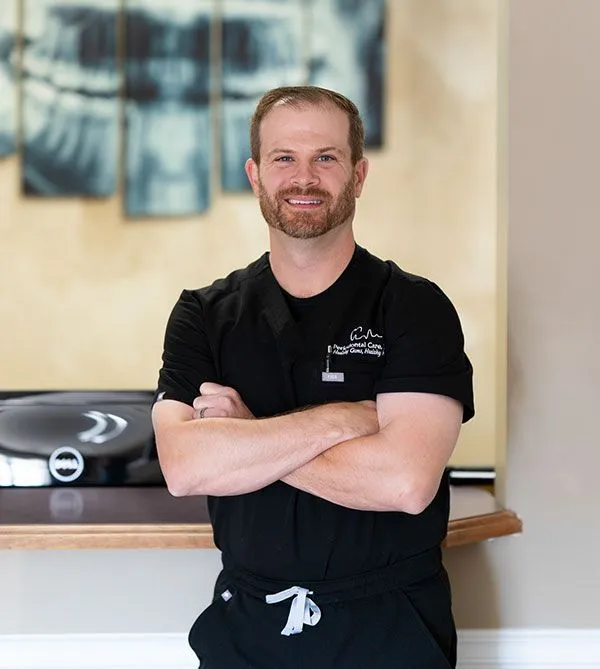
CEO, Peridontal Care, P.A.
Dr. Adam McClellan is a board-certified periodontist and CEO of Periodontal Care, a specialty group with five locations across the Kansas City metro that he built over roughly a decade through seven acquisitions and mergers. Licensed in both Kansas and Missouri, he graduated with top honors from the University of Missouri–Kansas City's dental and periodontal programs, where he earned the American Academy of Periodontology's student achievement award and the Pierre Fauchard Academy's merit award.
His clinical focus is hard and soft tissue reconstruction, periodontal microplastic surgery, and the surgical placement of dental implants, and he is certified in LANAP laser therapy through the Institute for Advanced Laser Dentistry. He founded the Northland Dental Study Club and holds memberships in the American Academy of Periodontology, the American Academy of Osseointegration, and the Midwest Society of Periodontology. He is currently expanding the group's in-house IV sedation services.