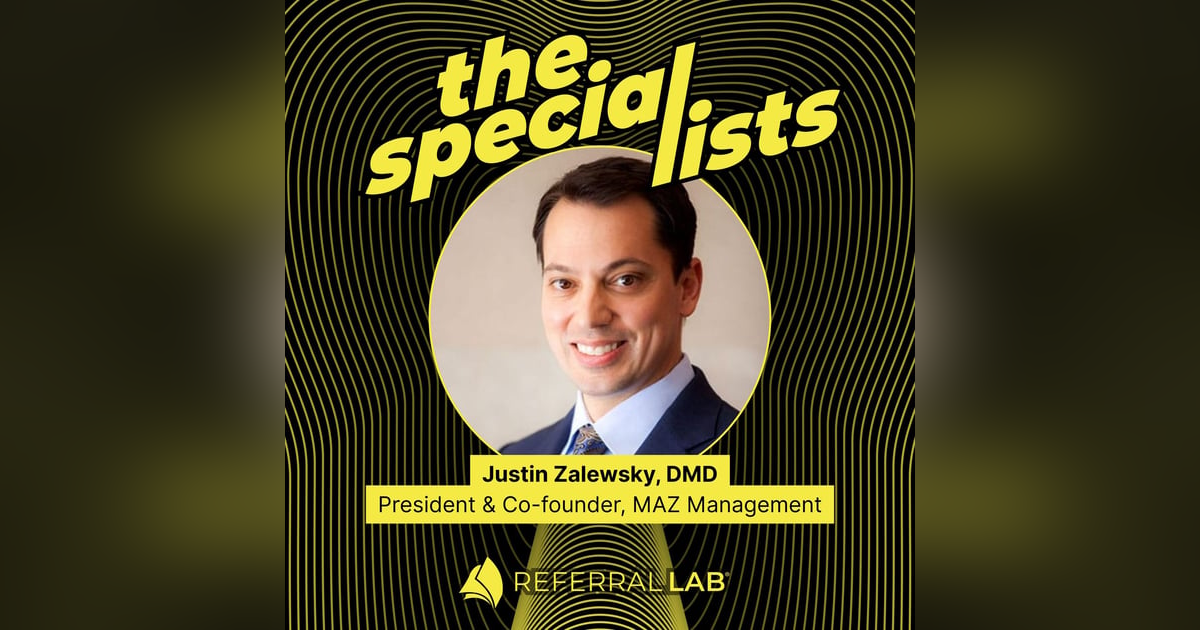
Special List #17: How Structure and Core Values Drive Better Hiring with Dr. Justin Zalewsky


Beyond clinical skill, running a successful dental practice requires clear vision, strong systems, and the right people.
Periodontist and MAZ Management co-founder Dr. Justin Zalewsky shares the leadership principles that guide his approach, including organizing life into three buckets — work, thinking, and personal time — and using tools like impact filters to keep projects and teams aligned.
He explains how core values and structure shape hiring, promotions, and day-to-day decision-making.
Justin also addresses the challenges of hiring associates, emphasizing mentorship, clear expectations, and structured onboarding.
GUEST
Justin Zalewsky, DMD
President & Co-founder, MAZ Management
Justin is a board-certified periodontist who has practiced in the Washington, D.C. metro area for more than 15 years. Seven years ago, he co-founded MAZ and began expanding through strategic acquisitions, building a network that now includes three periodontal practices and four general dental offices. Today he leads an organization of more than 80 team members and 15 doctors, supported by a centralized management team that allows him to remain an active clinician while guiding the company’s growth. His leadership focuses on developing strong teams, placing people in roles where they can thrive, and building practices that deliver exceptional patient care.
Learn more about MAZ Management
Learn more about Alexandria periodontist Dr. Justin Zalewsky
Connect with Justin on LinkedIn
The Special Lists, presented by Referral Lab, is the podcast for dentists and dental specialists.
Running a dental practice isn’t easy, and if you’re in private practice, it can sometimes feel like you’re on an island. That’s why finding your people—those who’ve been in your shoes and can share real, lived experience—changes the game.
Referral Lab was built specifically for dental specialists, helping you track, manage, and convert every referral. It’s about improving case acceptance, boosting team performance, and strengthening relationships with referring providers so your whole practice runs smarter.
This spirit of connection fuels The Special Lists podcast. Hosted by the team behind Referral Lab, we bring you wisdom from practice owners and dental professionals, sharing the wins, mistakes, and lessons that shape how they run their businesses today.
Got a question for us? Send us a message at speciallists.com
Transform your referral workflow with Referral Lab, the purpose-built platform for dental specialists to track, manage and convert every referral. Request a demo at referrallab.io
Cameron Full
Co-Founder of Referral Lab
Cameron Full, co-founder of Referral Lab, is a strategic problem-solver with expertise in business management and digital solutions. He combines leadership, creativity, and technology to drive success across various industries.
Connect with Cameron on LinkedIn
Jason Souyias, DDS
Periodontist and Co-Founder of Referral Lab
Dr. Jason Souyias is a periodontist, educator, and co-founder of Referral Lab software. He teaches dentists and hygienists, including as a Pikos Institute faculty member. In his Port Huron private practice, he's known for excellent patient communication and experience. He's passionate about his work and dedicated to helping other dentists.
More about Port Huron, Michigan periodontist Dr. Jason Souyias
Michael Seda, DMD, MS
Periodontist and Co-Developer of Referral Lab
A clinician and entrepreneur, Dr. Seda brings 19 years of private practice experience to his periodontal and implant surgery practice in the San Francisco Bay Area.
Dr. Seda’s interests are rooted in evaluating and influencing private practice management systems in dentistry. He wants to increase practice efficiency, establish a greater sense of collaboration and trust among practice team members, and enhance quality of care and service delivered—all while maximizing and growing profitability.
Through associateship opportunities early in his career, Dr. Seda was exposed to various private practice leadership and business models. He witnessed first-hand inconsistencies in the degree of success and failure owners experienced in private practices. This ignited his passion for learning what empowers practices to thrive and grow successfully while delivering a highly satisfying patient experience.
He is particularly interested in using cutting-edge analytics platforms to measure advanced practice metrics. He leverages these to design data-driven strategies to enhance referral patterns, scheduling systems, case acceptance rates, and other key performance indicators that lead to practice growth and patient satisfaction.
His education spans several disciplines, including a degree in Psychobiology from the University of California, Los Angeles, a Doctorate degree from Harvard University (DMD), and a Master’s degree in Periodontics and Oral Medicine from Columbia University.
More about Bay Area periodontist Dr. Michael Seda
Follow Dr. Seda on Instagram @sedaperio
Co-hosts: Cameron Full, Jason Souyias, DDS & Michael Seda, DDS
Producer: Eva Sheie @ The Axis
Assistant Producers: Mary Ellen Clarkson & Hannah Burkhart
Engineering: Cameron Laird
Theme music: Papa Funk, spring gang
Cover Art: Dan Childs
The Special Lists is a production of The Axis: theaxis.io
Dr. Souyias (00:00):
Thanks for listening to The Special Lists, presented by Referral Lab, the podcast for dentists and dental specialists.
Cameron Full (00:09):
Welcome to another episode of The Special Lists. I'm here with my co-hosts, Drs. Jason Souyias.
Dr. Souyias (00:17):
Good evening.
Cameron Full (00:18):
And Dr. Michael Sada.
Dr. Seda (00:21):
Living for a glitch-free life.
Dr. Souyias (00:26):
That comment comes from the fact that it just took us 30 minutes to get this thing rolling.
Dr. Seda (00:31):
Hey man. What doing? What do you do?
Dr. Souyias (00:33):
I think it's important to know.
Cameron Full (00:34):
Tonight we welcome Dr. Justin Zalewsky to the show. Welcome, Justin.
Dr. Zalewsky (00:39):
Thanks for having me.
Cameron Full (00:41):
Of course, man. We're happy to have you here. Close personal-
Dr. Seda (00:44):
Justin Z.
Cameron Full (00:46):
Yeah. He might be called Jay-Z during it. It's just Z sometimes a plethora of other things we may call him. Justin's a close personal friend of everybody in the show and he's got just a plethora of knowledge that we can't wait to chat with him for the next, I don't know, 45, 50 minutes about all sorts of random things. I'm sure that'll come up. So intro to Justin here. He is the president, co-founder of Maz Management, board certified periodontist who practiced in Washington, DC metro area for more than 15 years. Seven years ago, he co-founded Maz and began expanding through strategic acquisitions, building a network that now includes three periodontal practices and four general dental offices. Today, he leads an organization of more than 80 team members and 15 doctors supported by a centralized management team that allows for him to remain an active clinician while guiding the company's growth.
(01:40):
His leadership focuses on developing strong teams, placing people in roles where they can thrive and building practices that deliver exceptional patient care. That's Jay-Z. Jay-Z, what did I miss?
Dr. Zalewsky (01:54):
Taxes.
Cameron Full (01:57):
Notable achievements, 20 plus years in dentistry, three years in the Air Force as a GD15+ in perio, co-founded MAZ, scaled to seven locations, led a team of 80, and still finds time to be a family first father. That's actually something that I very much look up to you as a friend. You put your family first. It's remarkable. Before we get into all the fun stuff that the specialist is about, tell us about this trip that you took to the North Pole.
Dr. Zalewsky (02:28):
Interesting. Yeah. So every Thanksgiving, we try to do a family vacation. And this year we ended up up in the North Pole, went up to Finland, and then from there up to the North Pole to visit Santa's Village and mainly though just to track the northern lights. One of the things I did with the kids and Mel last year was made everybody come up with five bucket list things they wanted to do before our oldest finished high school, because she's a freshman right now. And so we've just been trying to work through the bucket list and actually two of us had see the northern lights on it. So that was the trip up there. It was like, I don't know, minus 20, 30 degrees and just an awesome, awesome time. I recommend it for anybody. It was one of the best trips we've ever taken.
Cameron Full (03:26):
I think the best part is where you spiffed the guy to get ahead of the line for the dog sleading.
Dr. Zalewsky (03:32):
It wasn't to get ahead of the line. It was just to make sure it happened because we only had one day that we could get it done. And yeah, they were sold out of spots. So it was one of those times where my wife was just like, "Go make it happen." And I did what I do.
Cameron Full (03:50):
Sure. Well, let's jump into your first item, Justin. Strategic vision and big picture thinking. Why first and fill us in a little bit on what you think about that.
Dr. Zalewsky (04:06):
So I'm involved in a couple different other organizations and one of the groups that I've probably spent the last, I don't know, 10 years of my life working with is Strategic Coach. And by far, the most influential thing I've done professionally and personally. It's the one thing that the beginning of the year goes on my calendar every year, first off. I won't miss that. And one of the things that they helped me focus on is their big thing is identifying unique ability. And I thought my unique ability was a lot of different things, but working with them was really, I see the board from a 30,000 foot view. I can see what's coming and usually predict the direction things are going a lot faster. So seeing that big picture has allowed me to maneuver and really helped with running the organization.
Cameron Full (05:02):
Sure. But back to the strategic coach stuff, when did you get into that? And tell us a little bit about how that immediately affected how you run your business.
Dr. Zalewsky (05:14):
I mean, when did I originally get into it? Well, one of my-
Cameron Full (05:17):
Because you've done the EOS stuff, you've done a whole bunch of those different things. And I know you quite well, this is one of the things that you've stuck with for a long period of time.
Dr. Zalewsky (05:25):
Yeah. I mean, I'm always looking for different things. And I mean, I try a lot of different stuff, but this is one that has really stuck because it affects every aspect of my life, both the business and the personal side of it. And I mean, I think that's the biggest takeaway of Strategic Coach is it's accountability. I'm paying for accountability and that's pretty much what I do. That's how they focus it, but it gives me a lot of other like- minded people. There's not many dentists in it, so I get to interact with a lot of other entrepreneurs and we focus on a lot of big idea type stuff.
(06:05):
And right out of the gate, they made me break up my life into three different buckets. There's where you're working on stuff, there's when you're thinking about the work, and then there's the personal time. So my whole life is broken down into those three buckets, working on the business, doing the work, and then my personal free time. And I split everything up into thirds like that, and they've just really helped me systematize everything even to ... One of the first tools that I used from them was an impact filter. And I mean, my whole life is all set up through Impact Filters, essentially having an idea of something I want to work on. And then you start from the back end of it, like what does success look like and then work it backwards. And then I like not to the point of who's involved in working on these, what's it take to get to my level?
(06:57):
So I mean, my entire team, everyone who works with me and interacts with me, I give them a breakdown of my expectations. And it's another tool that I've picked up where like, okay, if we're going to work on something together, these are the things that will annoy me. These are the things that are most important. This is what success looks like. And if you accomplish these things, we're going to be okay. So I mean, there's no great area really with me in that regard.
Dr. Seda (07:24):
I've heard Justin talk a lot about impact filters since I've known him. Jay, can you give an example of one area where you've used that to kind of achieve a goal or implementation of some idea that you have? Because Justin's got a ton of ideas. He thinks outside the box better than anyone we know, and he's the leader of a huge organization. And so I think a lot of the structure that you bring to that is something that our listeners would probably really benefit from. For you, it's probably second nature, but for them, I think an example would be really neat.
Dr. Zalewsky (08:00):
Yeah. So I mean, I think something we'll probably get into a little bit today is my new mentorship program that we're doing for associates. So that all started with an impact filter. So what was the goal? I wanted to create a mentorship program. What did it look like to find? What happens if I don't ... What's the best case scenario, the worst case scenario? And then just outlining all of the steps of what I needed to do. So it broke the project down. And then so again, I use it for everything. I mean, even my kids now know that if they want to try to get something across with me, fill out an impact filter and we can talk about it.
Dr. Seda (08:42):
You have blank copies laying around the house?
Dr. Zalewsky (08:44):
No, there are. There are. I mean, everybody that interacts with me has copies of these things on their phones, on their computers, there's print ones all over the office.
Cameron Full (08:54):
You're like, mother, did you fill out an impact filter?
Dr. Zalewsky (08:57):
Yeah.
Dr. Seda (08:59):
I know you want to go to the mall. Impact filter.
Dr. Zalewsky (09:03):
It's the biggest time save I've ever, ever implemented.
Cameron Full (09:09):
Then why did you get the second dog?
Dr. Zalewsky (09:11):
Why did we get ... Because they filled out-
Cameron Full (09:13):
That did not go through impact filter.
Dr. Zalewsky (09:16):
Second dog. I mean, we've had a lot of pets. The amount of fish that we've gone through, they thought I opened a sushi restaurant. I mean, I was blacklisted from the pet store. So all of that stuff, all of the pets we've had have all been my oldest daughter, Madeline's, and Abby never had a pet. And so she had to do something and we made an agreement that if she accomplished something, then she could get a dog. And so she did it and I'm holding up my end. So I got a second dog coming to ruin my life in three weeks.
Cameron Full (09:59):
They thought I opened a sushi restaurant.
Dr. Seda (10:04):
But to bring it back to what we were talking about, being the leader of a big organization, it takes structure to be able to manage all of that. Impact filters being one of them. And I think one of the other neat things about how you have things structured is you have things broken down into departments and you have leaders of each department and how you organize that and meet with those leaders. Can you touch a little bit on, just in terms of for a lot of us, the thought of a multi-practice, multi-location situation is a lot to digest, but for you, it's like you thrive in it. And so the way you organize it, I think is a big part of your success.
Dr. Zalewsky (10:49):
Well, look, I mean, it's no secret that my secret weapon is my wife, Melanie, who helps me run all this. I mean, she founded this with me as the co-founder and her skillset as a implant ... I mean, she was an implementer and worked at a large scale consulting company. So coming into dentistry is a no-brainer for her and she brings a lot of that. But I mean, our org chart is pretty set up and everybody understands how our org chart works, and that's beneficial for the entire team because everybody knows who they answer to. I mean, I have two different operations managers, but everyone knows who to go to for specific things. We're very defined in who takes care of what. And this isn't me saying I don't believe in cross-training. Cross-training's important, but somebody's got to be in charge. There's always got to be a primary.
Cameron Full (11:44):
Absolutely.
Dr. Zalewsky (11:46):
The more doctors, the more staff you have, I mean, it's just, look, my kids are better behaved than my staff. And then they try to play one against the other. I mean, the running staff would be easy if they all lived with me or I could implement some form of shock callers, but that's not allowed. The thing is, people, I personally believe nobody ever wants to do a bad job. Absolutely. Nobody shows up to work saying, "I want to be a failure today."
Cameron Full (12:21):
Yeah, I would agree with that.
Dr. Zalewsky (12:24):
So as a leader and as a leader in our organization, my biggest flaw is that I'm always looking for the best in people and always willing to give somebody another chance. It has been one of my biggest successes, but one of my biggest fails also. Whenever the team is like, "We have to get rid of this person," I'm always trying to save them because I personally believe that that right steat is so important. Every one of our employees that are successful have started somewhere else, and we just had to find the right position for them. So the minute that they say they want to get rid of somebody, I'm instantly looking at, okay, well, what are they doing well and do we have them in the wrong position? So I always want to try to move somebody within the organization as opposed to letting them go. Now, sometimes the right seat for that person is on a bus leaving our office, but we got to find the right seat.
Dr. Seda (13:27):
Yes.
Cameron Full (13:28):
Yeah.
Dr. Seda (13:29):
And Justin, you have a card that you keep with you that has the principles of your organization kind of front and center.
Dr. Zalewsky (13:39):
Yeah.
Dr. Seda (13:40):
Can you talk a little bit about what those are and how you guys live each day to achieve those? Because I think they're great. They're very well thought out and I think worth talking about.
Dr. Zalewsky (13:53):
Yeah. I mean, look, it's no secret that I am a quick start to the end degree. I'm a go, go, go. I've jumped off the cliff before I've even thought about what the consequences. I'm halfway falling before I even think about it. So we were very intentional in how we hire and the people that we hire to help me with that flaw that I have. So you're talking about our core values, Sada, that you brought up. I mean, our core values, we live them every day. We hire based off of them, we fire based off of them, we promote based off of them, and it's a constant. I mean, the one that I-
Dr. Seda (14:38):
Why don't you just read them off? Read them off, because I think they're succinct and I think worthwhile.
Dr. Zalewsky (14:43):
Yeah. So you have to be accountable, you have to be growth mindseted, you have to be funergetic, and you have to have a we mentality.
Dr. Seda (14:50):
Simple.
Dr. Zalewsky (14:51):
Simple, simple.
Cameron Full (14:53):
Funergetic. What's funnergetic?
Dr. Zalewsky (14:54):
Funergetic. So I've never worked a day in my life. I believe you have to have fun. Dentistry sucks. Nobody likes it. The patients don't like it. The team doesn't like it. It's like you have to have fun. I mean, the thing I preach to every new hire is, you got to remember, we hurt every patient twice. They come in the back, have the procedure done, then they have to come up front and pay for it. Nobody likes the dentist. Okay?
Dr. Souyias (15:18):
I'm not even sure how to respond to that. Yeah, that's true.
Dr. Zalewsky (15:22):
It's 100% true. So I mean, here's the thing though. So just off of that thing, we know that the two most impactful times of any appointment is the beginning of the appointment and the end of the appointment, right?
Cameron Full (15:38):
Absolutely.
Dr. Zalewsky (15:39):
So how they enter and how they exit. So a lot of people put payment is the last thing that happens in the office. You do the procedure and then they pay for it and then leave. So the last thing they remember leaving your office is that they had to pay you- Paying the big bill. ... for whatever you did to them. So we put the payment on the front side of it so that when they're leaving, all they're doing is getting a, "Oh, everything went so well today. Your appointment's already set. We'll see you next time." So when they're done, they're done. We clean them up, we get them out. And that has been a huge change just because ... So you want to take that end memory and the worst part of it, paying for it and put it in a different part of the appointment, put it prior to the appointment, before the start of the procedure or whatever, the people, "Oh, well, what if you change the procedure?" Okay, whatever, then you adjust it.
(16:25):
But that happens like what, 3% of the time? I don't care. Yeah. So funergetic is just like, we like to have fun. You will hear in our office, even in our surgical office, there is laughter all the time. I mean, nothing is more fun than what I'm about to do or doing a surgery on somebody and the patient is laughing and chuckling about it. I mean, I get a ton of feedback from people. I have not had this much fun ever at a dental office before.
Dr. Seda (16:55):
And as Justin's friend, I can attest to the fact that he believes and strives for the four F's. Fun, fanaticism.
Dr. Souyias (17:09):
Wait, wait, wait. Keep going. What are the other two? That's two. Come on, Seda.
Dr. Seda (17:19):
I'll let you fill in the blanks.
Cameron Full (17:25):
He started with four and realized he had two.
Dr. Zalewsky (17:28):
No, he had four. He just realized he probably shouldn't put the other ones out there.
Cameron Full (17:37):
Oh, man. All right. Let's skip to the second point here. Justin actually talked a little bit about this in the previous point, but the idea of agile leadership and organizational adaptability. Now, I have been privy to a Tuesday morning phone call a couple times during our friendship in which Justin's making an agile change. What was it, two or three years ago you called and you're like, "Cam, I'm the HR director this morning." And you're like, "Hey, I got to get some different people in different seats." And so you talked a little bit about this, but go in a little more depth on what you mean about organizational adaptability, Jay.
Dr. Zalewsky (18:20):
So look, we're getting to that size. And I mean, I think every organization struggles with this. Change is hard for everybody. Nobody likes change. It's uncomfortable, but it's necessary. And I love change. I mean, my team has guardrails that if things are going too well, they know that I'm going to come in and try to blow something up. It's just because I'm always looking for what's the other shoe to fall. So if things are going too well, you need to be worried, I usually feel. It's my highly optimistic personality that I guess goes that way. But organizational adaptability is like, I believe in change. I want to always constantly be improving. So if you don't have change, you can't improve, then you're stagnant. And as the organization gets bigger and larger, it's harder and harder to make changes. It's like a small boat versus a big boat. When you're in a small speed boat, you can make the change and the turn quickly. As the boat's bigger, it's harder to make that change. So I'm always forecasting, and as the CEO of the organization, my primary job is don't hit the iceberg. Yeah.
Cameron Full (19:34):
Yeah. My father-in-law said it best. He operated a fair amount of restaurants and he said, "Cameron, you ever try to turn the Titanic?"
Dr. Zalewsky (19:39):
Right.
Cameron Full (19:41):
Yeah.
Dr. Zalewsky (19:41):
No.
Cameron Full (19:42):
So as you add more people, as you add more initiatives, as you add more offices, as you add more patients, it gets harder and harder to turn.
Dr. Zalewsky (19:50):
It does. But you have to be willing to make those changes because as you get bigger and bigger, the mistakes become more and more costly.
Cameron Full (19:57):
For sure. Yeah. I think that's one thing that you're good at too, is you're able to make that, you're able to identify those things quickly, Jay. And so you typically shift quickly, which is obviously where I hope we talk about it before the end of the night goes, that clinical leadership function that you're moving into.
Dr. Zalewsky (20:14):
Yep.
Dr. Souyias (20:15):
The other thing though is when the size of the organization, when you have that larger organization, it's harder. It takes a little longer, not only to correct course, but it takes a little longer to go off course, right?
Dr. Zalewsky (20:26):
Yes.
Dr. Souyias (20:27):
So as long as you're making the positive changes and constantly working to continuous improvement like you're talking about, that's really important. But also know that it gives you a little grace if you do make a change that isn't the best. Let's say you have a great culture, you have a large organization, you make one bad hire. As long as you correct it, it's not as impactful as if you have two people working on your team and you make one bad hire, that third person can really destroy things. Yes. Right? So it does give you a little buffer zone on some of that stuff too, but not unless if you're not paying attention to it, it can become really dangerous.
Dr. Zalewsky (21:06):
Yeah. And I mean, I think that's one of the things that we're a little bit different with. I mean, for an office to be part of our organization, there's so many different ways for them to fit underneath our umbrella, whether they are branded into one specific line or whether they're an offshoot of something else. But I kind of focus that more on a doctor-specific situation. I never want to dictate care. I never want to be the organization that's going to see a doctor and saying, "Well, you're doing too many fillings and not enough crowns." If that's just what's there, then that's what's there. This idea of like, okay, you have to do 17 crowns a month or something and then hitting ... I mean, you don't know what patients are coming across. I mean, I never want to own a location or have a doctor work for me that I wouldn't send my own family to.
Dr. Souyias (21:56):
That's awesome. That does wonders for the culture of your organization.
Dr. Zalewsky (22:00):
Yeah. Yeah. And I mean, I think if we just did some 360 feedback from the organization, and so we are very, very high on our culture index for the locations, but there's a breakdown between the locations and the organization. Interesting. And I'm okay with that, to be honest, because as long as I have good culture in the office, that's okay. If I had great culture from the offices to the parent company, then I think it would be running more like a larger DSO type thing, which I don't want. So I actually like that there's that little bit of breakdown there.
Dr. Souyias (22:41):
So you don't mind running unlike their separate brands?
Dr. Zalewsky (22:44):
No, no. Nope. I mean, we only have a couple rules. I mean, we are in the process of bringing on two offices that we don't own that are going to be using our centralized services right now for some different things. And the rules that we implement on them are the same rules that we implement on the practices that I own. And it's pretty much like you have to use the same software we use because if you're not on the software, I can't do anything. And then for my practices, they have to be using the same banking as I am, but that's for legal reasons. But you have to be on the same software and you have to have the same phone system because if you don't have those things, then there's really not much I can help you with because I need to be able to have access from anywhere.
Dr. Souyias (23:35):
How do you deal with that? You don't want to dictate care to the doctors that you work with, but yet you definitely have levels of standard of care within your organization. How do you separate the difference in those?
Dr. Zalewsky (23:51):
So right now, I still wear the hat of the clinical director of the organization because we're not large enough for me to step out of that role. So we spend a lot of time reviewing treatment plans and I spend time with all the doctors and we're constantly ... I'm a numbers guy, so give me data and I love to break it down.That's what's so great about referral lab is the data that I can use to judge my doctors and benchmark them against. So if I have a doctor that-
Cameron Full (24:27):
Referral Lab.
Dr. Zalewsky (24:29):
If I have a doctor that is complaining about needing more new patients, I mean, the first thing I go look at is what's their case value? And I can dictate whether this doctor is burning through patients because they're not treatment planning or where their deficiencies are. And those are the things in our mentorship programs that we're constantly trying to identify and look and see how to fix these things.
Dr. Souyias (24:59):
Helps you find some holes where you can plug some of the holes of the buckets, right?
Dr. Zalewsky (25:02):
It does. Yeah. But it's not even about plugging the holes. It's really about identifying. I use it more for identifying the level of doctor that I'm working with.
Dr. Souyias (25:11):
Explain that more.
Dr. Zalewsky (25:13):
So we benchmark, we keep scorecards on all our doctors, and then each month we do a monthly scorecard review with each doctor. So we're looking at their number of new patients. The key things I look at is I want to know how many new patients they got. I want to know how many treatment plans were presented, want to know their case acceptance rate, and then I want to know what their average case presented, their average case accepted is. And then we have different benchmarks that we hold different doctors based off of experience or whether they're a lead doctor or a secondary doctor in a location or how much time they've been out. And so I use those numbers to benchmark them against each other.
Dr. Souyias (25:53):
So the balance with some of these organizations though, the challenge that doctors always want when we join organizations is, I want to be in charge and in control of my own destiny, but then how do you balance that when you're like, "Listen, here's how everybody else in the organization is doing and here's how you're doing." So how do you give them the coaching that they need without interrupting their autonomy?
Dr. Zalewsky (26:19):
Yeah. Well, I mean, so when you have that information and you're benchmarking them, because I routinely get, well, it's different here. It's different. My office is different or where I'm work, my patient pool is different. And so when we have that benchmark data that I can show them, okay, well, help me understand, you take the same insurance as this doctor, you use the same treatment planner as this doctor. How are your numbers so off from this? I'm not saying you're doing something wrong. I'm saying we've identified an area that we need to look at. And routinely, I mean, it comes down to usually two things. It's a confidence issue or a desire to be liked issue. Those are the two problems that I run into every single time when I have to coach an associate. It's never anything other than that or ... Well, I take that back.
(27:13):
There is a third type. It's confidence, it's the desire to be loved, or it's they are just money hungry SOBs that you got to get rid of. All right. And I can pick them out in a second because their case values are ... They're taking insurance and I'm fee for service and their case values are higher than mine. All right, we got a problem. This person doesn't belong here because everybody has a $20,000 treatment plan. All you're trying to do is just squeeze whatever you can out of a person, not saying it's right, not saying it's wrong, it's just not part of my organization.
Dr. Seda (27:48):
I love that. Yep. Good. But you're saying it's wrong.
Dr. Zalewsky (27:51):
I'm not ... I'm not saying it's wrong.
Dr. Souyias (27:57):
It's wrong for his organization.
Cameron Full (27:58):
He's got the jacket on. He's being agreeable.
Dr. Zalewsky (27:59):
The board is saying it's wrong usually.
Dr. Souyias (28:02):
Yeah, the board of dentistry in whatever state you're in.
Dr. Seda (28:06):
Tell me you feel it's wrong without telling me you feel it's wrong.
Dr. Zalewsky (28:09):
Yes.
Cameron Full (28:10):
Justin's turning over a new leaf on the podcast. For those that can't see that are listening, he's just smiling and shaking his head.
Dr. Zalewsky (28:21):
Yep.
Cameron Full (28:21):
Well, let's talk more about, you opened the door, Justin, into the clinical mentorship stuff, and you and I have been talking a lot about this over the last, gosh, what, six, nine months now heavily, putting a lot of time into what should this look like? What do these people want? And so you've been really spending a lot of your personal resource and then aligning your organization to be able to support you in a way that as you bring on new associates, creating relationships that last, that give both sides, both sides the partnership what they need. Talk a little bit about your thoughts on this and some of your plan.
Dr. Zalewsky (29:05):
Yeah. So look, I think anybody who hires an associate has the best intentions. They might not admit to themselves why they're doing it or not, but I mean, and we can have a whole discussion about why and when somebody should hire an associate. I mean, I think probably a high percentage of associates shouldn't be hired simply for the fact that they're hired for the wrong reason. And when I talk about the wrong reasons, either the practice is too slow, so they want to bring an associate on because they think that's their new marketing arm and that's going to grow their practice, which is the absolute worst, worst way to start off on. Or they're just thinking, "Well, I need to get an associate because this is my transition plan to get out of the chair and I'm going to bring somebody on because they're going to buy it from me, " which doesn't usually happen also.
(30:03):
And I mean, this has been a 12-year experiment for me that I've been working on this. And what I probably talk about today will be different a year or two from now because it's constantly changing and it took me this long to even identify the paths of associates. And I think the other thing is we, as doctors, and I'm going to speak to doctors who are single or one or two location doctors and bringing on an associate, I think when they look at bringing an associate on, they're looking more for like, okay, this is going to be the person that I want to bring on. I want a mentor and I want them to transition and take over my practice so this is my exit. Because I think that's kind of the standard approach that occurs a lot of times. Sure. And I think we don't believe or don't want to believe that most associates take the position as, okay, this is something I'm going to try out because I need a job, but have very little intention of this ever being their long-term home. If it works out, great, but if it doesn't, they're ready to pick up and move. And there's this idea of getting somebody out of school to take over your practice and the first person you hire working out, it's a rarity. I'm not seeing it. We just can't compete with the large DSOs and what they can offer these people.
Dr. Souyias (31:31):
I disagree with that too. There's things-
Cameron Full (31:33):
But not everybody wants ... Yeah, go ahead, Souyias.
Dr. Souyias (31:35):
There's things that we can offer them that the DSOs can't.
Dr. Seda (31:37):
For example.
Dr. Zalewsky (31:39):
Yeah, go ahead.
Dr. Souyias (31:39):
The mentorship part. The people in the DSOs, my experiences of what I've seen in these organizations is the mentorship's harder to get. Typically, you get people in most, and I'm generalizing a little bit, but most DSOs that I've seen, the senior doc sold because that's their exit plan. They don't want to put in the time to mentor, which is very different than how Justin's approaching this. Well- When you're saying we can't keep up, they have better benefit plans. Typically, they have better health insurance. Because the size of the organization absolutely does matter in those situations.
Dr. Zalewsky (32:20):
If someone coming out of school will make more money joining a large DSO their first year out than they will in traditionally in a standalone practice.
Dr. Souyias (32:32):
Depends on the practice.
Cameron Full (32:34):
Typically. Yeah. I would say that more often than you're right.
Dr. Souyias (32:38):
In their first year.
Cameron Full (32:40):
I mean, the amount of practices that are-
Dr. Zalewsky (32:42):
They have volume. We don't always have volume. Yeah. The amount of practices that are- If a periodont is coming into a perio practice, that ramp up to be a known and get busy takes time.
Dr. Souyias (32:55):
Correct.
Cameron Full (32:57):
If you're seeing the average amount of new patients, which in the perio space is 48, that's average. And converting the gold standard, which is 85% of referrals to consultation, then you have to be willing to hemorrhage tomorrow 60 referrals tomorrow before you would arguably be filling them with a full schedule. And most people aren't going to do that.
Dr. Zalewsky (33:23):
Nope.
Cameron Full (33:24):
Because that means that you as the senior doctor were willing to receive 120 or more depending upon ... And if you're seeing 120, you've gotten pretty used to that income. You have to be pretty willing to drop that production and change your schedule immediately. There's a lot of levers that have to pull at once for you to have a full associate.
Dr. Souyias (33:50):
Yeah. Or the other way is that you're not seeing 120, but you're getting those volumes and you've got a backlog. I think the biggest mistake that people make when hiring an associate is not having the volume.That's kind of what you were saying, Justin, is the biggest mistake that's made is not having the volume. The idea of, "Oh, my associate's going to be my new marketing arm," like you said, they're going to grow my practice within my ... It's total horseshit. It just doesn't happen. And it's not fair to these kids coming out of school.
Dr. Zalewsky (34:22):
I'm busy. I need an associate. I'm booked three weeks out.
Dr. Souyias (34:25):
Yeah. That's the average.That's average.
Dr. Zalewsky (34:28):
I mean, an associate is going to churn through that backlog in a week.
Dr. Souyias (34:31):
In one week. Exactly. Yeah. So I think the biggest mistake that's made when hiring an associate is not having an appropriate enough volume to at least ... Now, I'm not saying you have to fill them even to the average. Maybe you don't have to fill them to 48 consults a month. Get them halfway there. If you can at least get them halfway there, that's a reasonable base to start with. Then to expect them to grow it from there, it's reasonable. But maybe you have a different opinion, it looks like by your facial expression.
Dr. Zalewsky (35:02):
Yeah. Listen, no, I don't think it's even about having a backlog. It's about having conversations about setting reasonable expectations. Great. Okay. So I mean, if you're looking for a transition plan with a doctor and you don't have a backlog, but you want to be done in two years, then that's a totally different conversation than if you do have a backlog and you're trying to bring somebody in, but you want to practice for another 20 years, I mean, it just depends on what you're looking for. Correct. That's a good point. I believe everybody can bring an associate on at any time, as long as you're willing to have the conversations about what the next 12 months look like and stick to it. Every time I've hired an associate, we give every associate a set guarantee for the year. We guarantee that to them, but then I will sit down and work out with them what my expected production by month for them over that first 12-month period looks like.
(36:13):
All right. So we do every month what the expected goal for the month is. And usually, I'll usually pick somewhere like that between the fifth and seventh month, I'll put an X on the timeline. So I create a timeline and we lay it all out. And then I put an X on it at the sixth or seventh month mark, and now I make them sign it, and then I put that away.
Cameron Full (36:38):
Social contract.
Dr. Zalewsky (36:40):
All right. The reason being, when we're sitting there going through this and we're talking about hiring, they would all love to hit those goals for the month by month thing of their production, and they're on board with it because they work with me to help them set them and stuff. And then usually come around month five or six, something usually changes and you can usually pick up on it if you're aware of it. Then you start having conversations and they start saying they're not busy enough. They don't feel busy enough. They're not productive enough. And then I pull that paper out and we talk about ... I said, remember when we put this X here and I said, would talk about this later? I said, "This is us talking about that later." I said, "Tell me what has changed from six months ago when you were happy at the production that you said you would be happy with, you're out producing it and now you're not happy."
Cameron Full (37:31):
Yep.
Dr. Zalewsky (37:32):
And it happens every time.
Dr. Seda (37:34):
What's the response usually when you have that conversation?
Dr. Zalewsky (37:37):
Oh.
Dr. Seda (37:40):
So it brings some clarity for them.
Dr. Zalewsky (37:44):
Well, they then start saying yes, but, and then you got to start digging into it. And usually what happens is a lot of times they went from, it's a transition from being a student to now making money and living. And in a lot of cases, we don't realize this, but this is the first job a lot of these people have ever had in their life ever. And they're making money and they're starting to realize like, oh crap, there's these things called taxes and I have to start paying for groceries and stuff. And they don't realize how to budget money. So it's really more a budget conversation than it is anything else.
Dr. Souyias (38:32):
Agreed.
Dr. Zalewsky (38:33):
But it happens every single time.
Dr. Souyias (38:36):
And I think that's probably especially difficult in an area like yours that has an extremely high cost of living.
Dr. Zalewsky (38:41):
Yeah. Yeah. I mean, in this area, they just put something out that if a family is making less than $150,000 a year, you cannot live in the area.
Dr. Souyias (38:51):
Wow. Yeah,
Dr. Zalewsky (38:52):
It's crazy.
Dr. Souyias (38:52):
Brutal.
Dr. Zalewsky (38:54):
Yeah.
Cameron Full (38:55):
What else on that topic should we talk about, Justin? Because it's been a ... Talk a little bit about-
Dr. Zalewsky (39:01):
So mentorship's tough-
Cameron Full (39:04):
Your onboarding changes. Talk a little bit about your check-in changes, how you're planning to communicate with these individuals in a group setting clinically. Some of these things that you're looking to adopt and evolve that you've done recently.
Dr. Zalewsky (39:21):
So it's different for each person, but we've set some standards for the organization that we now do weekly doctor calls where all the doctors have to get on just a quick check-in call and we just do a quick round table. And then we have a monthly meeting that all of the doctors are required to show up for that has an agenda that we cover. It's just a way for me to get all of my ... And I have a different one for the general and one for the specialty one. So we do that. And then you have your monthly scorecard review, and that happens. That's the standard for every doctor. And then for a new doctor on the mentorship-
Cameron Full (40:06):
What's on the scorecard review before ... I don't want to interrupt you. I want you to finish that up, but go back to what's on the scorecard review.
Dr. Zalewsky (40:11):
So our scorecard review, we attack it from a couple different aspects. We look at the numbers that we talked about before, number of new patients, your collections, your acceptance rate, average case value, average accepted value. So we have discussions about that. And that usually then leads into ... Then we have a ... So it's an hour meeting every month. So we talk about that, then we review some treatment plans and just start looking to try to identify some areas where there's some problems like, okay, you're at 100% acceptance on implants, but you're at 3% on your tissue graft cases and start having discussions about that. So we identify areas that we need to focus and work on with that. And then we start having our marketing conversations where we bring our marketing team in and we are talking about, okay, who are the new referrals?
(41:05):
Who's trending up? Who's trending down? Who's new? And then we set our marketing cadence for the next month at that meeting because we try to set the marketing one month in advance and we've gotten it very dialed in now where it's more intentional as opposed to just market.
Cameron Full (41:28):
Spray and pray.
Dr. Zalewsky (41:29):
Yeah, no, it's really dialed in on who and how and what we do in those situations. And that's what happens for every doctor in the org on the specialty side. Every periodontist has those three things that occur org wide. And then the mentorship's a little bit different. When you're coming on board, we have a lot more interaction with me. I have usually daily phone calls because I don't work with every doctor every day because I move around the offices, so I don't have that ability to be with every co-associate, but I do talk to them every day. Then we have a weekly treatment planning conversations, and we spend a lot of time teaching them how to talk to patients. I find that's one of the biggest issues. So we record all of their new patient exams, and I review those with them, and then we're building out a catalog of other cases so that I have all of mine recorded and stuff so that I can show them, "All right, well, look, you were talking about a full arch case here. Let me pull up a couple ones that I've done so you can kind of see how I've presented them versus how you've presented them."
Cameron Full (42:44):
Sure.
Dr. Zalewsky (42:44):
But you have to have a lot of discussion beforehand with them before you just say, "Okay, we're going to be recording." Because it's an awkward situation for most people, but I've always recorded myself for different things. I used to, even as a resident, I would record myself doing my lit review presentations just so that I could watch them just to see.
Cameron Full (43:05):
Do you record yourself weightlifting?
Dr. Zalewsky (43:10):
Not all the time, but I have yes.
Cameron Full (43:13):
You did.
Dr. Zalewsky (43:14):
Yep.
Cameron Full (43:15):
You're so vain.
Dr. Zalewsky (43:19):
If I'm trying to change a lift for a certain reason and add a new-
Cameron Full (43:24):
I know. I'm just hassling you.
Dr. Zalewsky (43:25):
... for a reason. It's more for technique.
Cameron Full (43:28):
Yeah. Final topic quick. We got a couple more minutes left. Let's talk about team development. Or actually, Justin, would you rather talk about team development strength-based leadership or practice growth and integration?
Dr. Zalewsky (43:39):
Let's talk about the team.
Cameron Full (43:40):
Okay.
Dr. Zalewsky (43:40):
I'm fine with that.
Cameron Full (43:41):
Do it. Team development, strength-based leadership, identifying people's unique abilities and placing the rules where they can thrive. Talk about that.
Dr. Zalewsky (43:48):
Yeah. I mean, this goes back to what I said earlier about trying to find the right seat for people, and then giving them the tools to grow and develop. I'm a big proponent of trying to hire from within and promote from within. We are always looking at bringing people up through the organization. Everybody who's in my leadership, we haven't hired into leadership in quite some time. Usually it's somebody who's within the organization that we've identified, and then we kind of build them up. Every employee in the organization has a five-year plan. It doesn't matter what you do.
Cameron Full (44:23):
Nice.
Dr. Zalewsky (44:24):
When you start, every single person has a five-year plan.
Cameron Full (44:27):
I didn't know that. That's wonderful. I think that you look at some of that stuff, Justin, and you can see how Strategic Coach has influenced you because that is not something you'd hear from a typical ... I don't even think I've heard that before in the dental space. And taking the ownership, knowing that it's your responsibility to support your team, making them feel that you're invested in them is half the battle.
Dr. Zalewsky (44:56):
Yeah.
Cameron Full (44:57):
How can I get you to where you want to go?
Dr. Zalewsky (44:58):
Right. Well, it also helps them identify what they want to do and what they want to be.
Dr. Souyias (45:03):
Where do they want to go?
Cameron Full (45:03):
Absolutely.
Dr. Zalewsky (45:05):
And it's a lot easier for somebody to stay somewhere if they know where they're going. Yeah. I mean, most positions in dentistry, they're ceilings. Cap out. I was talking to one of my doctors the other day, and I never thought about it this way. They're a doctor who's in their mid- 30s or so, and she needed a new assistant, and we were sending people to her, and she called me and she was like, "Listen, can you talk to HR? Please stop sending me these highly experienced assistants," is what she said. And talking to her, I was like, "Well, finally I was like, okay." I finally got her to say, "Stop sending me old people. " And I was like, "Wait a minute." I was like, "Well, why do you think that? " And her thing was, "I want to work with somebody who's willing to grow and change." And it wasn't an age thing.
(46:00):
It was more a, these people who have a lot of experience want me to do it their way and not the way that I want to do it or the new and changed way, trying to identify what these people want. And you don't know if you don't talk to them about it. So I mean, if you're hiring somebody who you're hiring them in as assistant and you're building them and developing their team, but really all they want to do is be in cybersecurity and they have no problem telling you this when you start laying out the plan and stuff. And it's like, okay, well, I'm not going to send you to go be trained as a phlebotomist if your plan is to be gone next year.
Dr. Souyias (46:47):
But thanks for being honest, right? It's okay. Not everybody has to have that.
Dr. Zalewsky (46:52):
Yeah. Listen, because we give everybody, they all have an amount of money that they can use for education. If they can justify how it betters them and betters them for the organization, I'll pay for anything. I don't care. I mean, we've paid for people to go be scuba certified, that they made a good enough case to me that we could justify it.
Cameron Full (47:16):
This is a wonderful conversation. I envy how willing you are to be wrong with your group. And I think it's something that we can always strive towards within our own individual businesses and practices is the acknowledgement that there's always a better way and you're willing to always try to find that. And so this latest associateship function and how you're approaching that is just, it's the future of your org and you know it. And so dedicating your appropriate time and resources there like you have is awesome.
Dr. Souyias (47:54):
Very smart.
Dr. Zalewsky (47:55):
I brought it up that this mentorship program that we are implementing now didn't come about until I had been able to identify the three different paths of an associate. Every associate starts and then they ramp up. And then once they get to a certain point, there's three different ways they can go. They're either going to decline and they're on their way out, they plateau and they're just a set of hands that just want to keep working for you or they're partner material and they're on an upward trajectory. The goal is to identify that as soon as possible of which path they're on and then be involved in leading them along that path as quickly as possible.
Dr. Souyias (48:38):
Makes great sense.
Cameron Full (48:39):
Awesome. Justin, thanks for joining us today.
Dr. Zalewsky (48:42):
Yeah. Thanks for having me guys.
Cameron Full (48:42):
Today, this evening on The Special Lists. And as always, appreciate your insights and look forward to the next conversation.
Dr. Zalewsky (48:50):
Yeah. It's been fun.
Dr. Souyias (48:51):
It's good to have you on man. Thank you.
Dr. Zalewsky (48:53):
Later guys.
Dr. Souyias (48:56):
Thanks for listening to The Special Lists. Presented by Referral Lab, the podcast for dentists and dental specialists. Featuring a special list from a specialist. Got a question for us? Send us a message at speciallists.com with two Ls. Transform your referral workflow with Referral Lab, the purpose-built platform for dental specialists to track, manage, and convert every referral. Request a demo at referrallab.io.